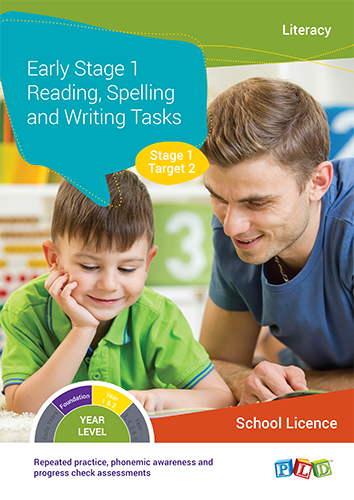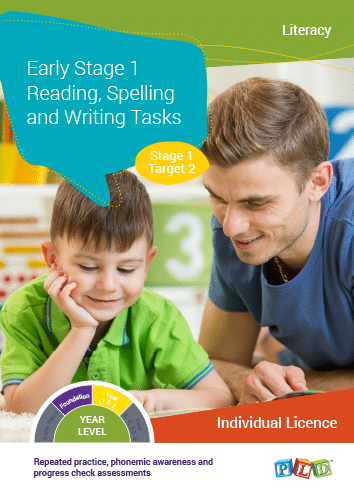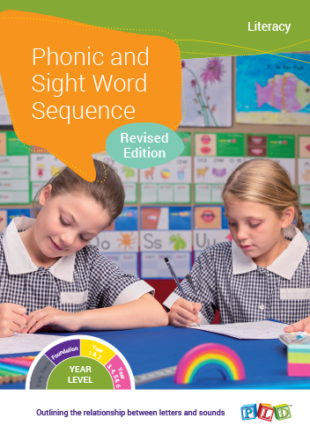
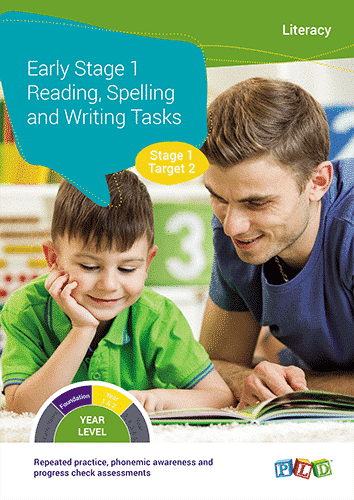
Repeated practice, phonemic awareness and progress check assessments with A4 Colour Cards and Worksheets.
Introduction to the Program
This program is designed to support the development of early reading and spelling skills by focusing on CVC word structures with Target 2 digraphs. The resources focus on incorporating phonics, phonemic awareness and multi-sensory strategies to segment and blend CVC words with Target 2 digraphs.
The Program Includes:
Sound out & Spell CVC words with 8 phonic concepts
‘th’ (voiced) & ‘th’ (voiceless)
‘sh’
‘ch’
‘ee’
‘oo’ (long) & ‘oo’ (short)
‘ck’
Sentence reading & writing of CVC words with 8 phonic concepts
3 Sound Phonemic Awareness Cards with 8 phonic concepts
This is a PLD Individual Licence resource. By purchasing this licence, this program will be accessible as a digital flipbook that will be stored in your secure account on the PLD website and may only be accessed by an individual user, being the Purchaser.
The program will be accessible as a digital flipbook that can be accessed by the purchaser on any device for as long as the licence is active. An Individual Licence is valid for 12 months from the date of purchase.
Sharing of an Individual Licence or account credentials for the purpose of sharing an Individual Licence is a breach of Australian Copyright Law and PLD Terms of Use. For more information,
visit our Individual Licence FAQ.
Repeated practice, phonemic awareness and progress check assessments with A4 Colour Cards and Worksheets.
Designed by a Speech Pathologist for use in schools and the home, this program for 5 to 6 year olds focuses on developing early literacy reading and spelling abilities with the phonic concepts sh, ch, th, oo, ee and -ck. The explicit teaching format incorporates multiple word reading and spelling tasks.
In order for phonic based reading and spelling materials to be effective children must possess adequate phonemic awareness skills. This resource incorporates a significant phonemic awareness element. While this is ideal for the dyslexic and learning difficulties population (who are typically insensitive to the phonemic structure of words and rely on the visual appearance of words) this approach has proven to effectively accelerate early reading and spelling skills with the more mainstream population.
Attention to mouth movements involved in producing the sounds in words heightens children’s attention to the phonemic structure and supports the organization of the letter symbols in spelling and the decoding of the symbols in reading. The combination of the attention to the oral, auditory and visual aspects achieves balanced word attack strategies and significantly accelerates the acquisition of the earliest reading and spelling steps.
The aim of this resource is to establish the ability to read and spell regular phonic words. For some students, once this skill is established they then require multiple opportunities to practice this skill (e.g. reading 200 to 300 such words) before these basic words are read automatically (i.e. without sounding out). For students who require more practice and rehearsal, the games based program Stage 1 Single Word Decoding and Spelling Skills is recommended.
This is a PLD Whole School Licence resource.By purchasing this licence, this program will be accessible as a digital flipbook that will be stored in your secure account on the PLD website. The program will be accessible as a digital flipbook that teachers can access on any device for as long as the licence is active. A School Licence is valid for 12 months from the date of purchase and can be shared with all staff employed at the school.We highly recommend that either the Principal, Deputy Principal or a member of the admin team purchase the School Licence in order to manage the account and its users. For more information,visit our Whole School Licence FAQ.
Repeated practice, phonemic awareness and progress check assessments with A4 Colour Cards and Worksheets.
Designed by a Speech Pathologist for use in schools and the home, this program for 5 to 6 year olds focuses on developing early literacy reading and spelling abilities with the phonic concepts sh, ch, th, oo, ee and -ck. The explicit teaching format incorporates multiple word reading and spelling tasks.
In order for phonic based reading and spelling materials to be effective children must possess adequate phonemic awareness skills. This resource incorporates a significant phonemic awareness element. While this is ideal for the dyslexic and learning difficulties population (who are typically insensitive to the phonemic structure of words and rely on the visual appearance of words) this approach has proven to effectively accelerate early reading and spelling skills with the more mainstream population.
Attention to mouth movements involved in producing the sounds in words heightens children’s attention to the phonemic structure and supports the organization of the letter symbols in spelling and the decoding of the symbols in reading. The combination of the attention to the oral, auditory and visual aspects achieves balanced word attack strategies and significantly accelerates the acquisition of the earliest reading and spelling steps.
The aim of this resource is to establish the ability to read and spell regular phonic words. For some students, once this skill is established they then require multiple opportunities to practice this skill (e.g. reading 200 to 300 such words) before these basic words are read automatically (i.e. without sounding out). For students who require more practice and rehearsal, the games based program Stage 1 Single Word Decoding and Spelling Skills is recommended.
Books: PLD’s books may be used by the authorised purchaser within their classroom, however there are restrictions regarding modifying, copying or sharing. Full details can be found here.
School Licences: A School Licence allows access to a resource to be shared with an unlimited number of employees who are employed by the ‘Authorised purchaser’. These resources can be accessed by multiple users simultaneously and can be printed (subject to restrictions) or displayed by employees of the ‘Authorised purchaser’ within their classroom. Learn more here.
Downloadable resources & screening tools: These resources can be viewed, downloaded, printed and shared providing the resources are not modified in any way. Learn more here.
Breaches of Australian Copyright Law are taken seriously and may result in legal action being taken. Full copyright information can be found. Learn more here.
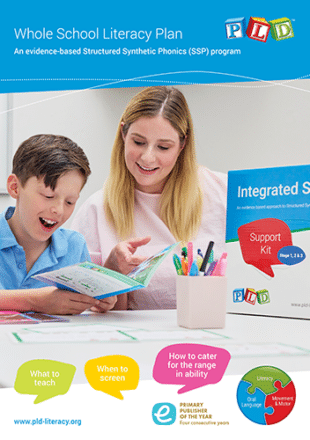
The document outlines how to implement PLD's literacy, Movement and Motor and Oral Language resources during the Early Years, Foundation, Year 1 & 2 and across Years 3 to 6. Each page provides suggested time frames and implementation recommendations.
The purpose of this document is to provide an implementation outline to assist schools in scheduling the PLD programs within a broad school-based strategy. When
A booklet that provides an overview of language, literacy and motor milestones for children in the foundation year (5 and 6 year olds). Tips for home and causes for concern are also outlined. The booklet can be photocopied back to back and then folded in half to provide a compact reference.
Life at Five! The five year old is characterised by energy and imagination. They are creative problem-solvers who are very interested in how the world
A fact sheet which identifies age related milestones for literacy development in children from 3 years of age. Included are decoding and spelling skill checklists for Stage 1 (or Year 1) through to Stage 5 (or Year 5).
Many parents wonder if their child’s reading skills are developing at the normal rate. While there are individual differences, there is a general progression of
Applying Phonic Knowledge to Extended Writing Tasks
Phonic Dictation: Stage 1 supports students to bridge the gap between correctly spelling test words and applying their skills to extended writing. By completing regular dictation tasks, students rehearse and reinforce their phonics and spelling knowledge in increasingly complex contexts, improving their ability to transfer skills to self-generated writing.
Dictation sessions are quick to prepare yet deliver significant benefits across key literacy areas, including:
Listening and auditory memory
Handwriting and language development
Spelling application
Program Includes:
A4, spiral-bound book.
Three levels of phonic passages: full-length passage format, ideal for Tier 1 students, and two shortened versions with reduced word counts for students requiring modifications.
Alphabet VC and CVC words.
Phonic concepts: /sh/ /ch/ /th/ /oo/ /ee/ /ck/ to CVC words.
Consonant blends: CCVC and CVCC words.
Phonic concepts: /ar/ /or/ /ay/ /ai/ /oy/ /oi/ /er/ /ing/
Additional passages covering concepts such as, prefixes, suffixes, high frequency words and homophones have been included in the APPENDIX section of the program.
Other Programs within the Range:
First Writing Activities (Foundation)
Phonic Diction: Stage 1
Phonic Diction: Stage 2
Phonic Diction: Stage 3
Phonic Diction: Stage 4
Phonic Diction: Stage 5
Phonic Diction: Stage 6
Phonic Diction: Junior & Middle Primary Set (Stage 1, 2, 3, 4)
Full Set of Phonic Diction Books (Discounted Bundle)
Phonic Diction: Stage 1 Catch-Up (For Older Students)
Phonic Diction: Stage 2 Catch-Up (For Older Students)
Bulk Order Discounts
5-9 copies: 10% off
10+ copies: 15% off
Links to the Teaching Sequence Manuals:
This product can be used to support the implementation of the Year 1 and 2 Teaching Sequence Manual
Strengthening the relationship between letters and sounds
Flash cards are a powerful instructional tool, not only are they an effective way to present, practise, consolidate and revise concepts at a whole class, small group or individual student level, but they also cater for the range of ability that presents in any class. Within Phonic flash cards, a wide selection of phonic concepts have been included making it a practical and handy resource.
For many classes, a proportion of students will present with advanced skills, a proportion will present with average or age-appropriate skills and a proportion will present with delayed skills. The students of greatest concern will be the students operating below the level of their peers. It is this group that will also require the greatest levels of on-going revision and consolidation. With this in mind, PLD have created Phonic Flash cards. One side of the flash cards are coloured and provide students with picture prompts. The other side lists the phonic concept without any supports. The resource also includes phonic concepts for the alphabet in stages 1-4.
How can Phonic flash cards be used in the classroom?
The traditional application, card flipping: The phonic concepts that have been covered in spelling lists can then be easily revised by collecting the associated phonic flash cards, hole punching the corners and placing them onto a metal ring. The specifically selected set of cards can be presented in an organised and time efficient manner.
Mount the flash cards on the wall for display: The display of the cards on a classroom wall creates an attractive wall frieze and thereby a phonic reference point for the students to source when engaged in written tasks.
Incorporate the flash cards into games: As a supplement to phonic-based spelling lists the flash cards can be incorporated into activities. This will help students be more curious and engaged in the task and thereby more likely to remember the concepts represented on the cards.
Generous discounts apply for bulk orders
5 to 9 copies – 15% discount applies
10+ copies – 20% discount applies
Outlining the relationship between letters and sounds.
Introduction to the Program
This essential guide outlines the PLD approach to implementing reading and spelling instruction from Foundation to Year 6.
The Program Includes:
A structured whole-school scope and sequence, outline phonic concepts, morphology, reading and spelling words, regular and irregular high-frequency words.
Termly assessments to establish the range in ability and reviewing progress.
Stages 1-3 focus on teaching essential phonic concepts and common-bound morpheme suffixes.
Stages 4-6 focus on extending alternative spellings of phonic concepts and more sophisticated word attack spelling based on syllables, prefixes, suffixes and morphemes.
Difficulty acquiring Stage 1 concept assessments to investigate slow-to-progress students.
Posters and guidelines on the explicit teaching of reading and spelling words in phonemes or syllables and irregular high-frequency words.
Other Programs within the Range:
CVC Words Reading, Spelling and Writing Tasks
Early Stage 1 – Reading, Spelling and Writing Tasks – Target 2
CCVC and CVCC Reading, Spelling and Writing Tasks – Stage 1 – Target 3
Reading, Spelling and Writing Tasks: CVC to Target 4 – Bundle
Links to the Teaching Sequence Manuals
This product can be used to support the implementation of the:
Foundation Teaching Sequence Manual
Year 1 & 2 Teaching Sequence Manual
Year 3-6 Teaching Sequence Manual
Ready to use resources for teaching phonic concepts, spelling and reading.
The Structured Synthetic Phonics Time-Savers for Stage 1 & Stage 2 program is designed to save time, simplify planning and to support educators in delivering impactful phonics lessons with ease. Aligned with the Phonic and Sight Word Sequence, the program includes resources that simplify lesson planning while delivering high-quality phonics instruction. The program is designed to support spelling and reading development through explicit instruction, practise and revision, ensuring that students achieve success in early literacy.
Program Includes:
A4 book: Spiral-bound, full colour and no preparation required.
Stage 1 & Stage 2 Colour-Coded Word Lists: Fully prepared, colour-coded spelling lists that highlight phonic patterns and sound structures for easy teaching and learning.
Student-Friendly Spelling Lists: Smaller, colour-coded versions of the word lists are provided for students, enabling independent learning and consolidation of concepts.
Flashcards for Phonics Concepts: Bright, engaging flashcards to introduce and reinforce phonics concepts effectively.
Rapid Automatic Reading Tasks: Focused activities designed to improve reading accuracy, speed and fluency.
Weekly Spelling Routines: Clear templates and activity guides to help structure spelling lessons and provide consistent practice.
Other Programs within the Range:
Structured Synthetic Phonics Time-Savers – Stage 1 & 2
Structured Synthetic Phonics Time-Savers – Stage 3 & 4
Structured Synthetic Phonics Time-Savers – Stage 5 & 6
Structured Synthetic Phonics Time-Savers – Stage 1-4 Junior & Middle Primary Set
Full Set of Structured Synthetic Phonics Time Savers
Links to the Teaching Sequence Manuals:
This product can be used to support the implementation of the Year 1 and 2 Teaching Sequence Manual on pages 11 – 22.
This website uses cookies to improve your experience while you navigate through the website. Out of these, the cookies that are categorized as necessary are stored on your browser as they are essential for the working of basic functionalities of the website. We also use third-party cookies that help us analyze and understand how you use this website. These cookies will be stored in your browser only with your consent. You also have the option to opt-out of these cookies. But opting out of some of these cookies may affect your browsing experience.
Necessary cookies are absolutely essential for the website to function properly. These cookies ensure basic functionalities and security features of the website, anonymously.
Cookie
Duration
Description
cookielawinfo-checkbox-analytics
11 months
This cookie is set by GDPR Cookie Consent plugin. The cookie is used to store the user consent for the cookies in the category "Analytics".
cookielawinfo-checkbox-functional
11 months
The cookie is set by GDPR cookie consent to record the user consent for the cookies in the category "Functional".
cookielawinfo-checkbox-necessary
11 months
This cookie is set by GDPR Cookie Consent plugin. The cookies is used to store the user consent for the cookies in the category "Necessary".
cookielawinfo-checkbox-others
11 months
This cookie is set by GDPR Cookie Consent plugin. The cookie is used to store the user consent for the cookies in the category "Other.
cookielawinfo-checkbox-performance
11 months
This cookie is set by GDPR Cookie Consent plugin. The cookie is used to store the user consent for the cookies in the category "Performance".
viewed_cookie_policy
11 months
The cookie is set by the GDPR Cookie Consent plugin and is used to store whether or not user has consented to the use of cookies. It does not store any personal data.
Functional cookies help to perform certain functionalities like sharing the content of the website on social media platforms, collect feedbacks, and other third-party features.
Performance cookies are used to understand and analyze the key performance indexes of the website which helps in delivering a better user experience for the visitors.
Analytical cookies are used to understand how visitors interact with the website. These cookies help provide information on metrics the number of visitors, bounce rate, traffic source, etc.
Advertisement cookies are used to provide visitors with relevant ads and marketing campaigns. These cookies track visitors across websites and collect information to provide customized ads.