FCp

Phonic flash cards – Stage 1-4

$55.00 (inc. $5.00 GST)
Code: FCp
Year Level: Foundation, Individual licence, School Licences, Year 1 & 2, Years 3 to 6
Book
Book
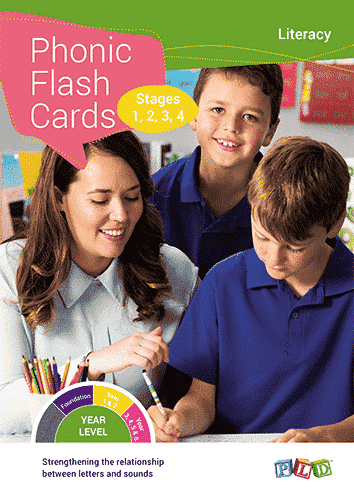
Strengthening the relationship between letters and sounds

Flash cards are a powerful instructional tool, not only are they an effective way to present, practise, consolidate and revise concepts at a whole class, small group or individual student level, but they also cater for the range of ability that presents in any class. Within Phonic flash cards, a wide selection of phonic concepts have been included making it a practical and handy resource.

For many classes, a proportion of students will present with advanced skills, a proportion will present with average or age-appropriate skills and a proportion will present with delayed skills. The students of greatest concern will be the students operating below the level of their peers. It is this group that will also require the greatest levels of on-going revision and consolidation. With this in mind, PLD have created Phonic Flash cards. One side of the flash cards are coloured and provide students with picture prompts. The other side lists the phonic concept without any supports. The resource also includes phonic concepts for the alphabet in stages 1-4.

How can Phonic flash cards be used in the classroom?

  1. The traditional application, card flipping: The phonic concepts that have been covered in spelling lists can then be easily revised by collecting the associated phonic flash cards, hole punching the corners and placing them onto a metal ring. The specifically selected set of cards can be presented in an organised and time efficient manner.
  2. Mount the flash cards on the wall for display: The display of the cards on a classroom wall creates an attractive wall frieze and thereby a phonic reference point for the students to source when engaged in written tasks.
  3. Incorporate the flash cards into games: As a supplement to phonic-based spelling lists the flash cards can be incorporated into activities. This will help students be more curious and engaged in the task and thereby more likely to remember the concepts represented on the cards.

Generous discounts apply for bulk orders

  • 5 to 9 copies – 15% discount applies
  • 10+ copies – 20% discount applies

FCp

Phonic flash cards – Stage 1-4 - Individual Licence

$27.50 / year (inc. $2.50 GST)
Code: Fcpil (Individual Licence)
Year Level: Foundation, Individual licence, School Licences, Year 1 & 2, Years 3 to 6
Book
Book
Add to quote

This is a PLD Individual Licence resource. By purchasing this licence, this program will be accessible as a digital flipbook that will be stored in your secure account on the PLD website and may only be accessed by an individual user, being the Purchaser. The program will be accessible as a digital flipbook that can be accessed by the purchaser on any device for as long as the licence is active. An Individual Licence is valid for 12 months from the date of purchase. Sharing of an Individual Licence or account credentials for the purpose of sharing an Individual Licence is a breach of Australian Copyright Law and PLD Terms of Use. For more information, visit our Individual Licence FAQ.

Strengthening the relationship between letters and sounds

Flash cards are a powerful instructional tool, not only are they an effective way to present, practise, consolidate and revise concepts at a whole class, small group or individual student level, but they also cater for the range of ability that presents in any class. Within Phonic flash cards, a wide selection of phonic concepts have been included making it a practical and handy resource.

For many classes, a proportion of students will present with advanced skills, a proportion will present with average or age-appropriate skills and a proportion will present with delayed skills. The students of greatest concern will be the students operating below the level of their peers. It is this group that will also require the greatest levels of on-going revision and consolidation. With this in mind, PLD have created Phonic Flash cards. One side of the flash cards are coloured and provide students with picture prompts. The other side lists the phonic concept without any supports. The resource also includes phonic concepts for the alphabet in stages 1-4.

How can Phonic flash cards be used in the classroom?

  1. The traditional application, card flipping: The phonic concepts that have been covered in spelling lists can then be easily revised by collecting the associated phonic flash cards, hole punching the corners and placing them onto a metal ring. The specifically selected set of cards can be presented in an organised and time efficient manner.
  2. Mount the flash cards on the wall for display: The display of the cards on a classroom wall creates an attractive wall frieze and thereby a phonic reference point for the students to source when engaged in written tasks.
  3. Incorporate the flash cards into games: As a supplement to phonic-based spelling lists the flash cards can be incorporated into activities. This will help students be more curious and engaged in the task and thereby more likely to remember the concepts represented on the cards.
FCp

Phonic flash cards – Stage 1-4 - School Licence

From $45.00$45.00 incl. GST / year (inc. $4.09 GST)
Code: Fcpvs (School Licence)
Year Level: Foundation, Individual licence, School Licences, Year 1 & 2, Years 3 to 6
Book
Book

Select your school size

Extra small

(<49 students)

Small

(50-149 students)

Medium

(150-349 students)

Large

(350+ students)

Add to quote

This is a PLD Whole School Licence resource. By purchasing this licence, this program will be accessible as a digital flipbook that will be stored in your secure account on the PLD website. The program will be accessible as a digital flipbook that teachers can access on any device for as long as the licence is active. A School Licence is valid for 12 months from the date of purchase and can be shared with all staff employed at the school. We highly recommend that either the Principal, Deputy Principal or a member of the admin team purchase the School Licence in order to manage the account and its users. For more information, visit our Whole School Licence FAQ.

Strengthening the relationship between letters and sounds

Flash cards are a powerful instructional tool, not only are they an effective way to present, practise, consolidate and revise concepts at a whole class, small group or individual student level, but they also cater for the range of ability that presents in any class. Within Phonic flash cards, a wide selection of phonic concepts have been included making it a practical and handy resource.

For many classes, a proportion of students will present with advanced skills, a proportion will present with average or age-appropriate skills and a proportion will present with delayed skills. The students of greatest concern will be the students operating below the level of their peers. It is this group that will also require the greatest levels of on-going revision and consolidation. With this in mind, PLD have created Phonic Flash cards. One side of the flash cards are coloured and provide students with picture prompts. The other side lists the phonic concept without any supports. The resource also includes phonic concepts for the alphabet in stages 1-4.

How can Phonic flash cards be used in the classroom?

  1. The traditional application, card flipping: The phonic concepts that have been covered in spelling lists can then be easily revised by collecting the associated phonic flash cards, hole punching the corners and placing them onto a metal ring. The specifically selected set of cards can be presented in an organised and time efficient manner.
  2. Mount the flash cards on the wall for display: The display of the cards on a classroom wall creates an attractive wall frieze and thereby a phonic reference point for the students to source when engaged in written tasks.
  3. Incorporate the flash cards into games: As a supplement to phonic-based spelling lists the flash cards can be incorporated into activities. This will help students be more curious and engaged in the task and thereby more likely to remember the concepts represented on the cards.
ISBN : 9 781925 057706
  • PLD's Decodable Reading Books Catalogue
    PLD’s Decodable Reading Books Catalogue

    PLD Decodable Reading Books are aligned with the Science of Reading and help students to build the right reading strategies. They necessitate the utilisation of

  • PLD's Whole School Literacy Plan
    PLD’s Whole School Literacy Plan
    The document outlines how to implement PLD's literacy, Movement and Motor and Oral Language resources during the Early Years, Foundation, Year 1 & 2 and across Years 3 to 6. Each page provides suggested time frames and implementation recommendations.

    The purpose of this document is to provide an implementation outline to assist schools in scheduling the PLD programs within a broad school-based strategy. When

  • Look Cover Say Write Check Poster
    Look Cover Say Write Check Poster
    Look-Cover-Say-Write-Check is a great strategy for children learning to spell.

    Download this useful spelling resource by clicking the link below. For more information on the LCSWC technique, view the video or our Learning to Spell blog.

  • Ages and Stages of Literacy Development - Ages 3 - 12
    Ages and Stages of Literacy Development – Ages 3 – 12
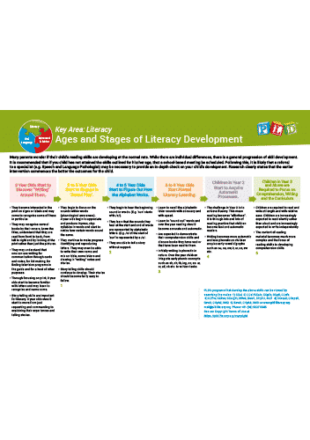
    A fact sheet which identifies age related milestones for literacy development in children from 3 years of age. Included are decoding and spelling skill checklists for Stage 1 (or Year 1) through to Stage 5 (or Year 5).

    Many parents wonder if their child’s reading skills are developing at the normal rate. While there are individual differences, there is a general progression of

People who viewed this also viewed...

  • Synthetic Phonics Flip Book – Stage 2, 3 & 4
    Synthetic Phonics Flip Book - Stage 2, 3 & 4

    Following on from our bestselling series Synthetic Phonics 1 & 2, comes Synthetic Phonics 3 in 2020. Synthetic phonics is a way of teaching children to read and spell. It has been identified as the most successful approach to establishing early literacy skills. The ‘synthetic’ component relates to the ‘synthesising’ or blending of phonemes (or individual speech sounds) and the ‘phonic’ component relates to written symbols (graphemes) being linked to the individual speech sounds (phonemes). When learning to read a child links letters to speech sounds and then blends them together to form words. When learning to spell a child separates or segments a word into the individual speech sounds within the word while linking the sounds to letters. This handy flip book resource is intended to provide important synthetic phonic concepts in a practical format that will assist when teaching the whole class or small groups of students. At Stage 3 children will be moving to syllabic spelling, which is chunking words by syllables while still paying attention to phonics. This resource is part of the Synthetic Phonics Flip Book range, view the other levels below: Synthetic Phonics Flip Book – Stage 1 & 2 Synthetic Phonics Flip Book – Stage 2, 3 & 4 Synthetic Phonics three Flip Books in a bundle Generous discounts apply for bulk orders 5 to 9 copies a 15% discount applies 10+ copies a 20% discount applies

    $75.00$75.00 incl. GST
  • Phonic and Sight Word Sequence
    Phonic and Sight Word Sequence
    Outlining the relationship between letters and sounds.

    Introduction to the Program This essential guide outlines the PLD approach to implementing reading and spelling instruction from Foundation to Year 6. The Program Includes: A structured whole-school scope and sequence, outline phonic concepts, morphology, reading and spelling words, regular and irregular high-frequency words. Termly assessments to establish the range in ability and reviewing progress. Stages 1-3 focus on teaching essential phonic concepts and common-bound morpheme suffixes. Stages 4-6 focus on extending alternative spellings of phonic concepts and more sophisticated word attack spelling based on syllables, prefixes, suffixes and morphemes. Difficulty acquiring Stage 1 concept assessments to investigate slow-to-progress students. Posters and guidelines on the explicit teaching of reading and spelling words in phonemes or syllables and irregular high-frequency words. Other Programs within the Range: CVC Words Reading, Spelling and Writing Tasks Early Stage 1 – Reading, Spelling and Writing Tasks – Target 2 CCVC and CVCC Reading, Spelling and Writing Tasks – Stage 1 – Target 3 Reading, Spelling and Writing Tasks: CVC to Target 4 – Bundle Links to the Teaching Sequence Manuals This product can be used to support the implementation of the: Foundation Teaching Sequence Manual Year 1 & 2 Teaching Sequence Manual Year 3-6 Teaching Sequence Manual

    $82.50$82.50 incl. GST