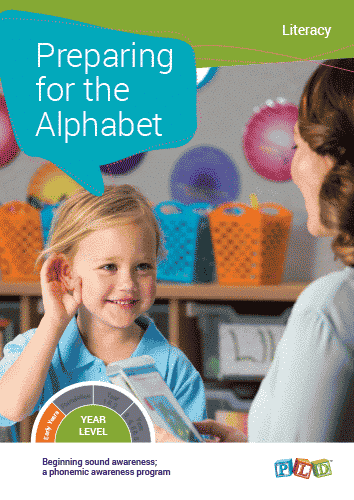
Beginning sound awareness: a phonemic awareness program
Preparing for the alphabet is designed for students aged 4 to 5 and sets about the basics required for pre-literacy. The explicit 5 minute sessions contain an outline of instructions and guidelines on how to effectively teach initial sound awareness. These instructions can form the basis of assistant and parent education. When Preparing for the alphabet is used in conjunction with PLD’s Pre-Literacy Screening this forms a significant component in a school’s early intervention strategy.
Children require the phonemic awareness skill of initial sound awareness in order to fully understand the alphabetic system. Why? When children are conscious of single sounds (i.e. they can ‘hear’ and ‘say’ the beginning sounds in words) only then does the alphabetic system make sense; as the alphabetic symbols represent sounds (or phonemes) in words. For example; When a child can identify that ‘sun’ starts with a ‘sssss’ and ‘tap’ starts with a ‘t’ it is then an ideal time to introduce the alphabetic symbols that correspond with the sounds that the child is aware of. Too often the alphabet is introduced without any explicit attention to initial sound awareness.
This must-have resource includes:
Instructions that provide clear guidelines on how to effectively teach initial sound awareness
Screening tool to determine readiness for an alphabet program
27 x mouth cards for continuant sounds with 120 x small activity picture cards
16 x mouth cards for stop sounds with 72 small activity picture cards
This is a PLD Individual Licence resource. By purchasing this licence, this program will be accessible as a digital flipbook that will be stored in your secure account on the PLD website and may only be accessed by an individual user, being the Purchaser.
The program will be accessible as a digital flipbook that can be accessed by the purchaser on any device for as long as the licence is active. An Individual Licence is valid for 12 months from the date of purchase.
Sharing of an Individual Licence or account credentials for the purpose of sharing an Individual Licence is a breach of Australian Copyright Law and PLD Terms of Use. For more information,
visit our Individual Licence FAQ.
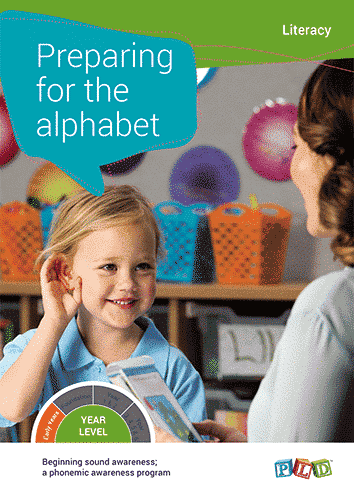
Beginning sound awareness: a phonemic awareness program
Preparing for the alphabet is designed for students aged 4 to 5 and sets about the basics required for pre-literacy. The explicit 5 minute sessions contain an outline of instructions and guidelines on how to effectively teach initial sound awareness. These instructions can form the basis of assistant and parent education. When Preparing for the alphabet is used in conjunction with PLD’s Pre-Literacy Screening this forms a significant component in a school’s early intervention strategy.
Children require the phonemic awareness skill of initial sound awareness in order to fully understand the alphabetic system. Why? When children are conscious of single sounds (i.e. they can ‘hear’ and ‘say’ the beginning sounds in words) only then does the alphabetic system make sense; as the alphabetic symbols represent sounds (or phonemes) in words. For example; When a child can identify that ‘sun’ starts with a ‘sssss’ and ‘tap’ starts with a ‘t’ it is then an ideal time to introduce the alphabetic symbols that correspond with the sounds that the child is aware of. Too often the alphabet is introduced without any explicit attention to initial sound awareness.
This must-have resource includes:
Instructions that provide clear guidelines on how to effectively teach initial sound awareness
Screening tool to determine readiness for an alphabet program
27 x mouth cards for continuant sounds with 120 x small activity picture cards
16 x mouth cards for stop sounds with 72 small activity picture cards
From $65.00$65.00 incl. GST / year(inc. $5.91 GST)
Code: ccpfavs (School Licence)
Year Level: Early Years
This is a PLD Whole School Licence resource.By purchasing this licence, this program will be accessible as a digital flipbook that will be stored in your secure account on the PLD website. The program will be accessible as a digital flipbook that teachers can access on any device for as long as the licence is active. A School Licence is valid for 12 months from the date of purchase and can be shared with all staff employed at the school.We highly recommend that either the Principal, Deputy Principal or a member of the admin team purchase the School Licence in order to manage the account and its users. For more information,visit our Whole School Licence FAQ.
Beginning sound awareness: a phonemic awareness program
Preparing for the alphabet is designed for students aged 4 to 5 and sets about the basics required for pre-literacy. The explicit 5 minute sessions contain an outline of instructions and guidelines on how to effectively teach initial sound awareness. These instructions can form the basis of assistant and parent education. When Preparing for the alphabet is used in conjunction with PLD’s Pre-Literacy Screening this forms a significant component in a school’s early intervention strategy.
Children require the phonemic awareness skill of initial sound awareness in order to fully understand the alphabetic system. Why? When children are conscious of single sounds (i.e. they can ‘hear’ and ‘say’ the beginning sounds in words) only then does the alphabetic system make sense; as the alphabetic symbols represent sounds (or phonemes) in words. For example; When a child can identify that ‘sun’ starts with a ‘sssss’ and ‘tap’ starts with a ‘t’ it is then an ideal time to introduce the alphabetic symbols that correspond with the sounds that the child is aware of. Too often the alphabet is introduced without any explicit attention to initial sound awareness.
This must-have resource includes:
Instructions that provide clear guidelines on how to effectively teach initial sound awareness
Screening tool to determine readiness for an alphabet program
27 x mouth cards for continuant sounds with 120 x small activity picture cards
16 x mouth cards for stop sounds with 72 small activity picture cards
Books: PLD’s books may be used by the authorised purchaser within their classroom, however there are restrictions regarding modifying, copying or sharing. Full details can be found here.
School Licences: A School Licence allows access to a resource to be shared with an unlimited number of employees who are employed by the ‘Authorised purchaser’. These resources can be accessed by multiple users simultaneously and can be printed (subject to restrictions) or displayed by employees of the ‘Authorised purchaser’ within their classroom. Learn more here.
Downloadable resources & screening tools: These resources can be viewed, downloaded, printed and shared providing the resources are not modified in any way. Learn more here.
Breaches of Australian Copyright Law are taken seriously and may result in legal action being taken. Full copyright information can be found. Learn more here.
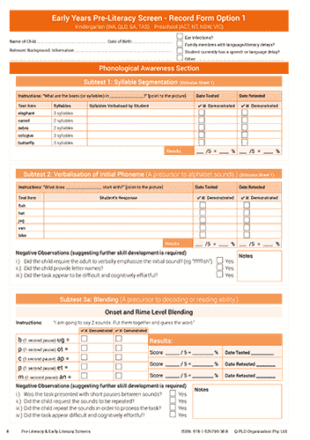
The Pre-Literacy Screens have been designed to profile the acquisition of core literacy precursor skills that will impact later reading, spelling and phonic development.
The screen focuses on two main skills: 1. Phonological Awareness: the ability to attend to the phonological structure or sound structure of words. 2. Alphabetic
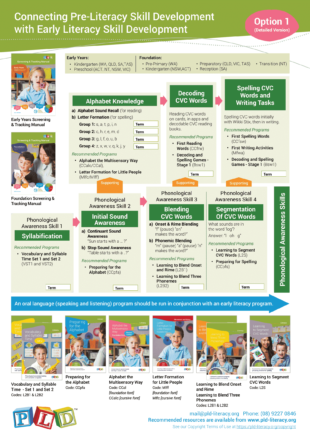
The document outlines how to implement PLD's literacy, Movement and Motor and Oral Language resources during the Early Years, Foundation, Year 1 & 2 and across Years 3 to 6. Each page provides suggested time frames and implementation recommendations.
The purpose of this document is to provide an implementation outline to assist schools in scheduling the PLD programs within a broad school-based strategy. When
At PLD we advocate for a strong junior primary process, in which the connections between classrooms and year levels is well organised. Most students require
Schools will have literacy results maximized over the long-term when they systematically plan how students progress from pre-literacy (or emergent literacy skills) into their early
A program for 4-6 year olds, incorporating Stage 1 phonic concepts.
Introduction to the Program
An A5 flipbook utilising a multi-sensory approach to help early readers master Stage 1 phonic concepts. By engaging visual, auditory, and tactile sense, children build a strong foundation in letter recognition, formation, and sound association.
The Program Includes:
Stage 1 – Target 1 alphabet sounds
Group 1: s, p, n, i, a, t
Group 2: m, r, h, e, d, c
Group 3: f, l, g, o, u b
Group 4: w, j, v, k, z, y, q, x
Stage 1 – Target 2 phonic concepts
‘th’ (voiced) & ‘th’ (voiceless); ‘sh’; ‘ch’; ‘ee’; ‘oo’ (long) & ‘oo’ (short); ‘ck’
Stage 1 – Target 4 phonic concepts
‘ng’; ‘ay’; ‘or’; ‘ar’; ‘ai’; al(l)’; ‘wh’; ‘qu’; ‘qu’
Multi-sensory cues to develop alphabet sound recall and formation
Mnemonic letter sound pictures
Verbal cues to support the correct letter formation of each letter
Mouth cues for the alphabet sound
Picture cues for the alphabet sound
Initial teaching cards with multisensory cues and consolidation teaching cards without cues.
Other Programs within the Range:
Alphabet the Multi Sensory Way – Cursive Font
Pre-literacy Flip Book Bundle
Phonic Sound Wall Charts for Foundation
Letter Formation for Little People – Step 1
Links to the Teaching Sequence Manuals
This product can be used to support the implementation of the:
Early Years Teaching Sequence Manual
Foundation Year Teach Sequence Manual
Year 1 and 2 Teaching Sequence Manual
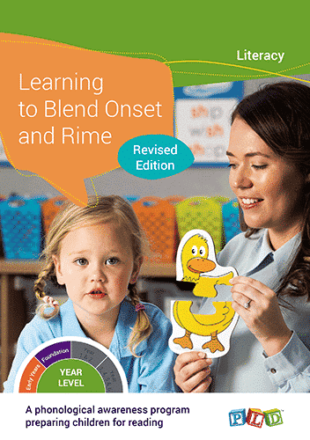
A phonemic awareness (onset and rime) blending program, designed to prepare children for reading.
Phonological awareness (and more specifically phonemic awareness) appears to unlock the mystery of word recognition and spelling. Once a child is conscious of the sounds that comprise words, the mapping of the sounds to the alphabetic system occurs with much greater ease.
The phonemic awareness pre-requisite for reading simple regular CVC [consonant-vowel-consonant] words such as ‘fig’, ‘tin’ and ‘mat’ is the skill of blending.
First students must learn to blend at an onset and rime level. E.g. ‘Listen carefully and put these sounds together and guess this word:’ ‘f’ (one second pause) ‘ig’?’
Students then learn to blend at the phonemic or individual sound level: E.g. ‘Listen carefully and put these sounds together and guess this word; ‘m’ (one second pause) ‘a’ (one second pause) ‘t’? Answer: ‘mat’.
The Phonemic Awareness Skill for Reading: Blending
Despite the research supporting the importance of blending, this skill is too often overlooked. The negative side of presenting reading activities without attention to the pre-requisite skill is that it does not set up all children for success. Within Learning to Blend Onset and Rime for Early Years and Foundation, the phonemic awareness skill of blending is targeted. Blending represents an immediate precursor to decoding ability. The colour card sets form the basis of short explicit instruction sessions. The scripted instructions provide clear guidelines on how to effectively teach blending. When this program is used in conjunction with screening this program forms a significant component in a school’s preventative/early intervention strategy.
Includes:
A no-preparation required spiral bound A5 full colour flip book.
Introduction/Note from the author.
Over 40 coloured picture which develop the skill of blending.
Each card has specific scripted instructions.
A progress check/skill assessment to review readiness for reading.
Aim for 2-3 minutes of blending several times a day.
The programs within the range include:
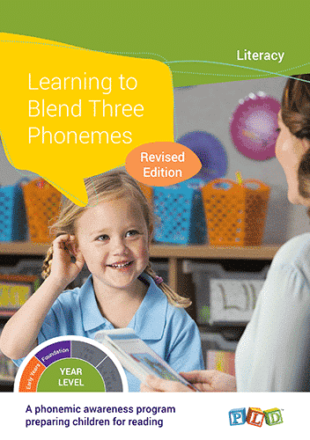
Learning to Blend Three Phonemes
Learning to Segment CVC Words
This product is mentioned in the Early Years Teaching Sequence Manual on page 6 and the Foundation Teaching Sequence Manual on page 7.
Phonemic Awareness Blending Program: Preparing Children for Reading
This phonemic awareness blending program is designed to prepare children for reading by developing their ability to blend sounds – a key skill for decoding CVC words such as; fin, tin and mat. Research highlights phonemic awareness as essential for word recognition and spelling, making it easier for children to map sounds to the alphabetic system.
Blending is taught in two stages:
Onset and Rime Level: Combining sounds like f and ig to form fig.
Phonemic Level: Combining individual sounds like m – a – t to form mat.
This program provides explicit, step-by-step instruction to build blending skills, which are crucial for early decoding success and preventing reading difficulties.
Program Includes:
A5 Flip Book: Spiral-bound, full colour and no preparation required.
Over 40 Picture Cards: Develop blending skills through engaging visuals.
Scripted Instructions: Clear, ready-to-use guidance for teaching blending.
Progress Check: Assess readiness for reading and track skill development.
Implementation: Use for 2-3 minutes, several times daily.
Other Programs within the Range:
Learning to Blend Onset and Rime
Learning to Segment CVC Words
Pre-literacy Flip Book Bundle
Links to the Teaching Sequence Manuals:
This product can be used to support the implementation of the Early Years Teaching Sequence Manual
This product can be used to support the implementation of the Foundation Year Teaching Sequence Manual
This product can be used to support the implementation of the Year 1 and 2 Teaching Sequence Manual for students working within Tier 2 and Tier 3.
This website uses cookies to improve your experience while you navigate through the website. Out of these, the cookies that are categorized as necessary are stored on your browser as they are essential for the working of basic functionalities of the website. We also use third-party cookies that help us analyze and understand how you use this website. These cookies will be stored in your browser only with your consent. You also have the option to opt-out of these cookies. But opting out of some of these cookies may affect your browsing experience.
Necessary cookies are absolutely essential for the website to function properly. These cookies ensure basic functionalities and security features of the website, anonymously.
Cookie
Duration
Description
cookielawinfo-checkbox-analytics
11 months
This cookie is set by GDPR Cookie Consent plugin. The cookie is used to store the user consent for the cookies in the category "Analytics".
cookielawinfo-checkbox-functional
11 months
The cookie is set by GDPR cookie consent to record the user consent for the cookies in the category "Functional".
cookielawinfo-checkbox-necessary
11 months
This cookie is set by GDPR Cookie Consent plugin. The cookies is used to store the user consent for the cookies in the category "Necessary".
cookielawinfo-checkbox-others
11 months
This cookie is set by GDPR Cookie Consent plugin. The cookie is used to store the user consent for the cookies in the category "Other.
cookielawinfo-checkbox-performance
11 months
This cookie is set by GDPR Cookie Consent plugin. The cookie is used to store the user consent for the cookies in the category "Performance".
viewed_cookie_policy
11 months
The cookie is set by the GDPR Cookie Consent plugin and is used to store whether or not user has consented to the use of cookies. It does not store any personal data.
Functional cookies help to perform certain functionalities like sharing the content of the website on social media platforms, collect feedbacks, and other third-party features.
Performance cookies are used to understand and analyze the key performance indexes of the website which helps in delivering a better user experience for the visitors.
Analytical cookies are used to understand how visitors interact with the website. These cookies help provide information on metrics the number of visitors, bounce rate, traffic source, etc.
Advertisement cookies are used to provide visitors with relevant ads and marketing campaigns. These cookies track visitors across websites and collect information to provide customized ads.


 Login
Login Register


 (0)
(0)

 Code: CCpfa


 Preview Book