Year Level:
Early Years, Foundation, Individual licence, School Licences
This is a PLD Individual Licence resource. By purchasing this licence, this program will be accessible as a digital flipbook that will be stored in your secure account on the PLD website and may only be accessed by an individual user, being the Purchaser.
The program will be accessible as a digital flipbook that can be accessed by the purchaser on any device for as long as the licence is active. An Individual Licence is valid for 12 months from the date of purchase.
Sharing of an Individual Licence or account credentials for the purpose of sharing an Individual Licence is a breach of Australian Copyright Law and PLD Terms of Use. For more information,
visit our Individual Licence FAQ.
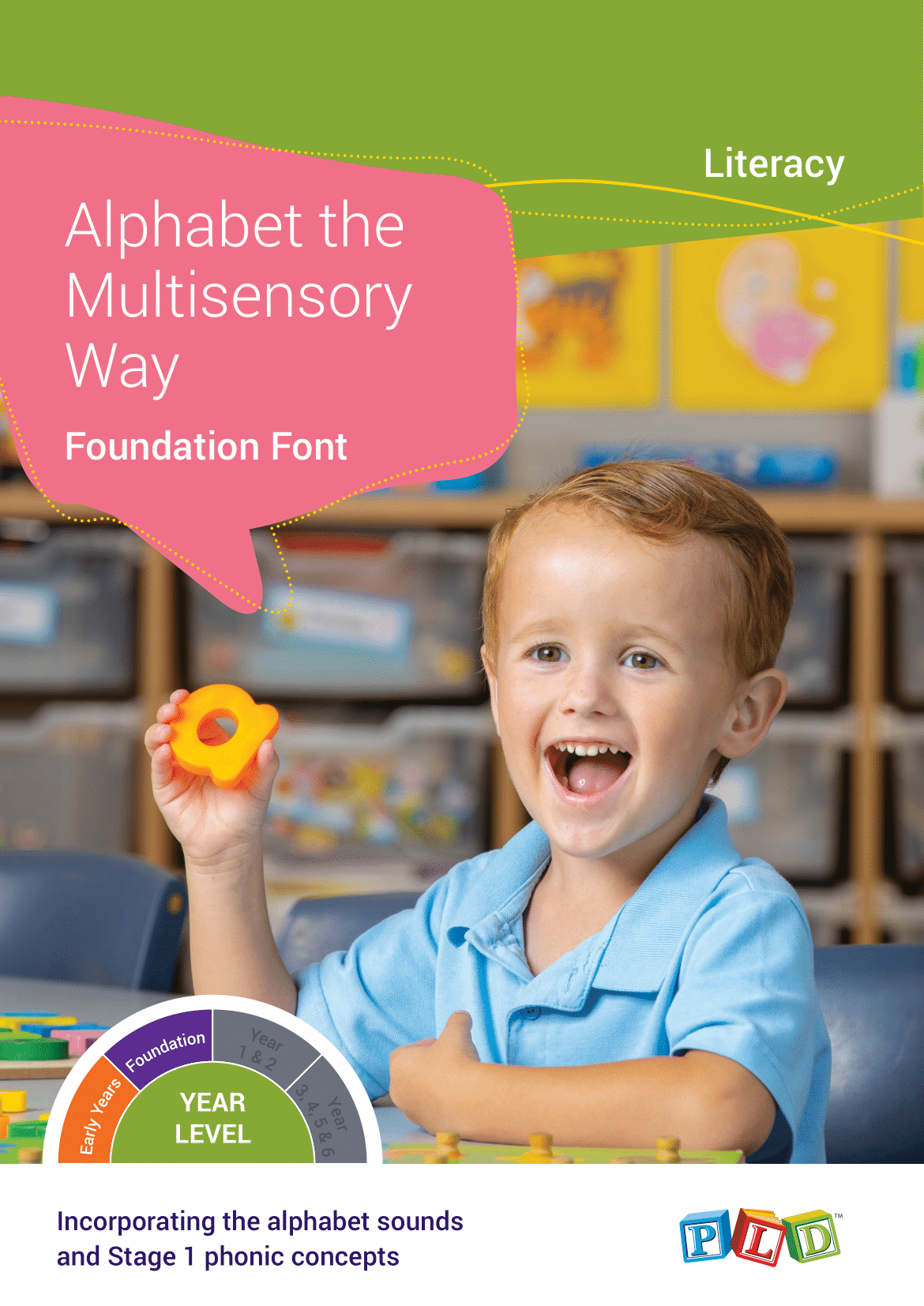
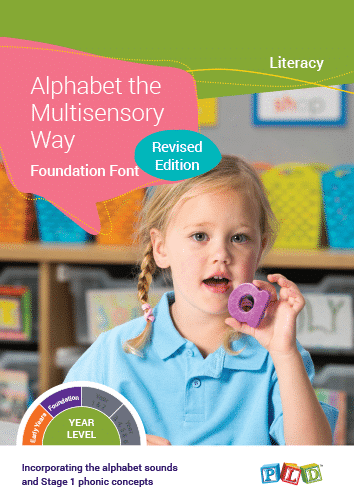
A program for 4-6 year olds, incorporating Stage 1 phonic concepts.
Students require alphabetic and phonic knowledge in order to embark on the process of learning to read, spell and write. However, rather than letter naming ability, sound knowledge is more important for entry into literacy learning.
Not only are alphabet sounds more important for early literacy, but alphabetic sound ability is more difficult for students to acquire. For this reason and designed by Speech Pathologists for teachers and parents, Alphabet the Multi Sensory Way aims to establish strong alphabet and phonic sound ability. Within this program for 4 to 6 year olds, a multi-sensory approach to teaching the alphabetic and phonic sounds has been adopted:
Students kinaesthetically feel what their mouth is doing when they produce the alphabet and phonic sounds.
Students see what their mouths look like when their mouths produce the alphabet and phonic sounds (via the visual representation of the mouth on each page).
Students also visually connect a core picture/word with the alphabet and phonic sounds (e.g. ‘mix’, ‘teeth’ and ‘snake’).
From an auditory (and phonemic awareness) perspective students identify the initial sounds in simple target words (e.g. teeth starts with a ‘t’).
Students move and rehearse a basic action associated with each target picture (which also engages a kinaesthetic dimension).
The order of presentation is:
Group 1: s, a, t, p, i, n
Group 2: c, h, e, r, m, d
Group 3: g, o, u, l, f, b
Group 4: j, z, x, y, k, q, w, v
Group 5: sh, ch, th/th, oo/oo, ee, ck
Group 6: ay, or, ar, er.ai, oy, (i)ng, oi, all
This flip book incorporating Stage 1 phonic concepts features:
Simple to use format.
Card sets explicitly teach the alphabet and phonic sounds.
Students feel their mouth making the sounds.
A body action is outlined for each sound.
An effective and engaging way to teach the alphabet and phonic sounds.
This product is mentioned in the Early Years Teaching Sequence Manual on page 6 and the Foundation Teaching Sequence Manual on page 7. This resource is also available in a cursive font.