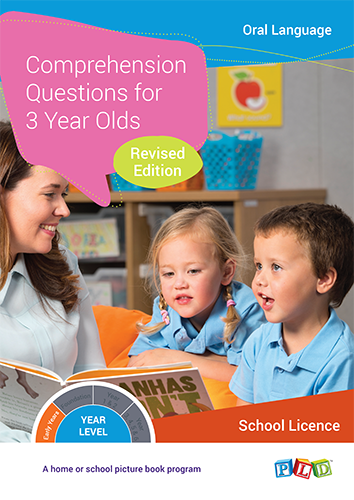
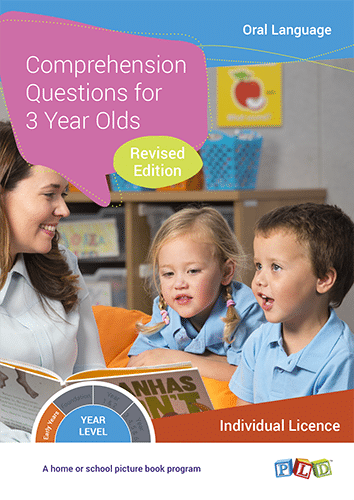
Picture Book Program for 3 Year Olds: Perfect for Home or School
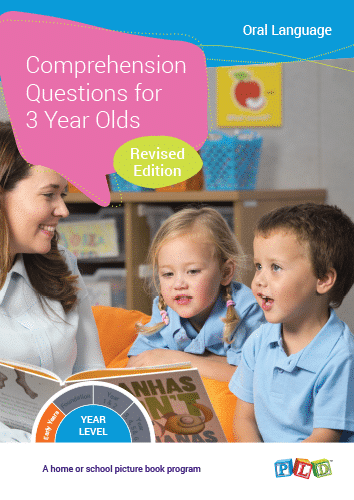
Comprehension Questions for 3 Year Olds is a home or school resource designed to support oral language development in young children. By age 3, children should be verbal, actively engage in social interactions and understand simple, literal questions about their surroundings. This program, developed by speech pathologists, supports the development of these foundational comprehension skills using engaging picture books to ask age-appropriate questions and assess oral responses. Oral language skills are critical for social interaction and academic success.
Program Includes:
Picture Book Recommendations: List of developmentally appropriate Picture Book recommendations, such as 'Spot Can Count', 'The Very Hungry Caterpillar' and 'We're Going on a Bear Hunt'.
35 Question Cards for Repeated Reading Sessions: Develop blending skills through engaging visuals.
Each card contains sample questions (over four days) and model answers based on each recommended picture book.
Questions focus on Blank Level 1 and 2 skills, such as 'What is it?' or 'What colour is it?'
Instruction Booklet: Guidance for presenting in group, class or home settings.
Strategies for Success: Techniques for responding to inadequate answers.
Progress Check: Two assessments to monitor comprehension skill development.
This is a PLD Individual Licence resource. By purchasing this licence, this program will be accessible as a digital flipbook that will be stored in your secure account on the PLD website and may only be accessed by an individual user, being the Purchaser.
The program will be accessible as a digital flipbook that can be accessed by the purchaser on any device for as long as the licence is active. An Individual Licence is valid for 12 months from the date of purchase.
Sharing of an Individual Licence or account credentials for the purpose of sharing an Individual Licence is a breach of Australian Copyright Law and PLD Terms of Use. For more information,
visit our Individual Licence FAQ.
A home or school picture book program for 3 year olds.
From the age of two, children should have a vocabulary of approximately 50 words and a sentence length of 2 to 3 words. Put simply, from a young age children should be very verbal. More importantly, they should love to engage with their peers and adults. Therefore, the ability to understand questions is critical for participation in social interactions and success across all curriculum areas. Comprehension Questions for 3 Year Olds has been developed as an essential resource for Oral Language Development. At this age, the level of questions are literal and based on what is in front of the child. For example: What is it? What part is this called? Who is this? Find one like this? What colour/size/shape is it? What does it taste/feel/smell like?
Designed for teachers and parents for use in schools, daycare and in the home this program provides parents and teachers of 3 year olds with:
Lists of developmentally appropriate picture books and comprehension questions.
Samples of 3 year old age appropriate answers and samples of inadequate 3 year old answers.
Techniques and strategies to implement when a child provides an inadequate answer.
An instruction booklet that outlines how the resource can be presented to a whole class, small groups or individual home setting.
35 cards that model appropriate questions and responses for the books listed in the Recommended Books For 3 year Olds such as ‘Spot Can Count’, ‘My Pet’, ‘The Very Hungry Caterpillar’, and ‘We’re Going on a Bear Hunt’
Following repeated reading of picture books the cards outline a collection of questions to be presented.
The questions focus primarily upon Blank (level 1 and 2 questions).
Two easy to administer progress checks; are included, to check on the acquisition of comprehension questioning ability.
This is a PLD Whole School Licence resource.By purchasing this licence, this program will be accessible as a digital flipbook that will be stored in your secure account on the PLD website. The program will be accessible as a digital flipbook that teachers can access on any device for as long as the licence is active. A School Licence is valid for 12 months from the date of purchase and can be shared with all staff employed at the school.We highly recommend that either the Principal, Deputy Principal or a member of the admin team purchase the School Licence in order to manage the account and its users. For more information,visit our Whole School Licence FAQ.
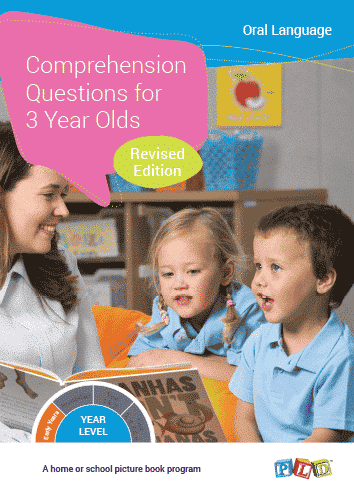
A home or school picture book program for 3 year olds.
From the age of two, children should have a vocabulary of approximately 50 words and a sentence length of 2 to 3 words. Put simply, from a young age children should be very verbal. More importantly, they should love to engage with their peers and adults. Therefore, the ability to understand questions is critical for participation in social interactions and success across all curriculum areas. Comprehension Questions for 3 Year Olds has been developed as an essential resource for Oral Language Development. At this age, the level of questions are literal and based on what is in front of the child. For example: What is it? What part is this called? Who is this? Find one like this? What colour/size/shape is it? What does it taste/feel/smell like?
Designed for teachers and parents for use in schools, daycare and in the home this program provides parents and teachers of 3 year olds with:
Lists of developmentally appropriate picture books and comprehension questions.
Samples of 3 year old age appropriate answers and samples of inadequate 3 year old answers.
Techniques and strategies to implement when a child provides an inadequate answer.
An instruction booklet that outlines how the resource can be presented to a whole class, small groups or individual home setting.
35 cards that model appropriate questions and responses for the books listed in the Recommended Books For 3 year Olds such as ‘Spot Can Count’, ‘My Pet’, ‘The Very Hungry Caterpillar’, and ‘We’re Going on a Bear Hunt’
Following repeated reading of picture books the cards outline a collection of questions to be presented.
The questions focus primarily upon Blank (level 1 and 2 questions).
Two easy to administer progress checks; are included, to check on the acquisition of comprehension questioning ability.
Books: PLD’s books may be used by the authorised purchaser within their classroom, however there are restrictions regarding modifying, copying or sharing. Full details can be found here.
School Licences: A School Licence allows access to a resource to be shared with an unlimited number of employees who are employed by the ‘Authorised purchaser’. These resources can be accessed by multiple users simultaneously and can be printed (subject to restrictions) or displayed by employees of the ‘Authorised purchaser’ within their classroom. Learn more here.
Downloadable resources & screening tools: These resources can be viewed, downloaded, printed and shared providing the resources are not modified in any way. Learn more here.
Breaches of Australian Copyright Law are taken seriously and may result in legal action being taken. Full copyright information can be found. Learn more here.
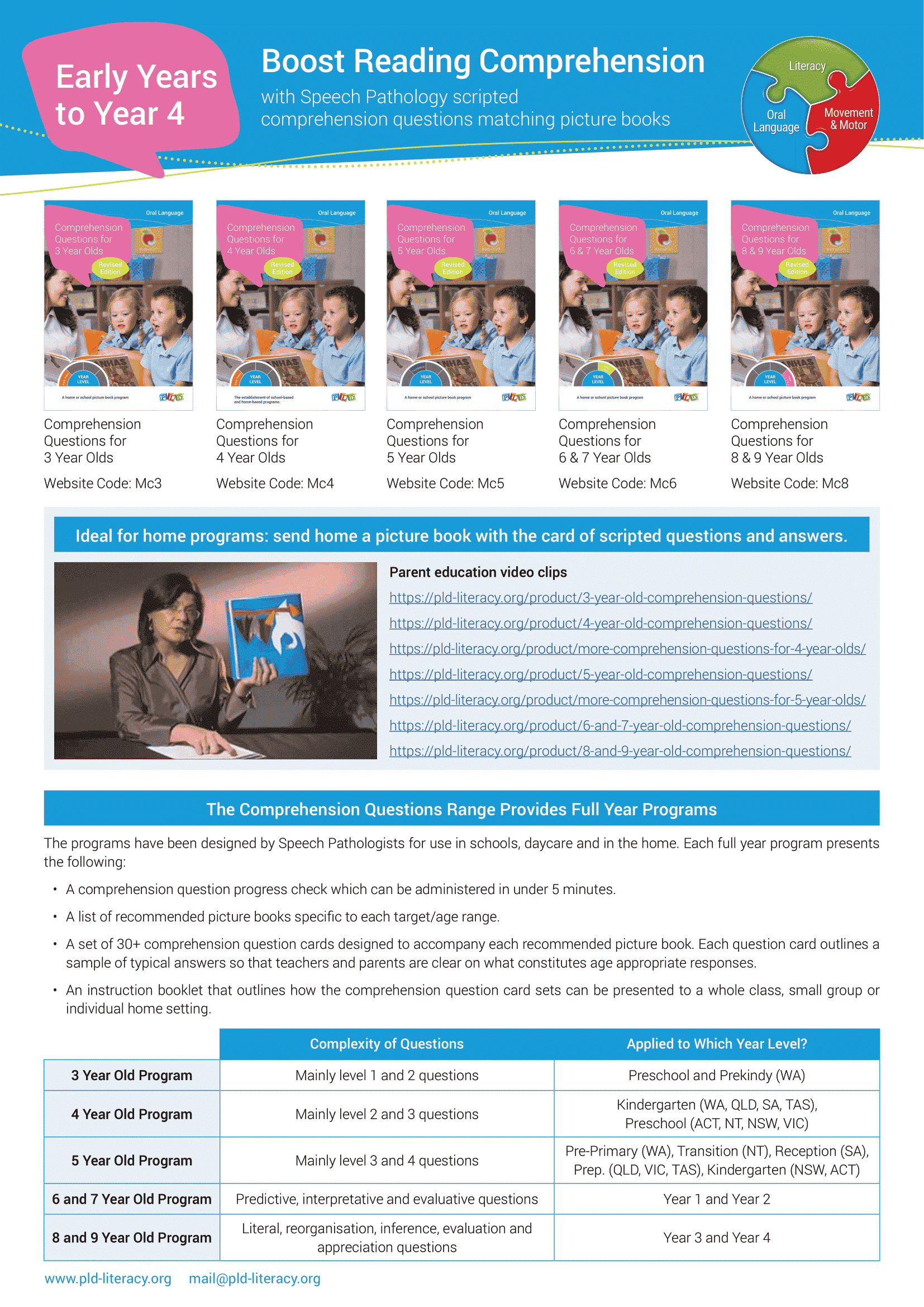
Boost reading comprehension with Speech Pathology scripted comprehension questions and matching picture books. Designed for use in the home or within schools. Contains a list
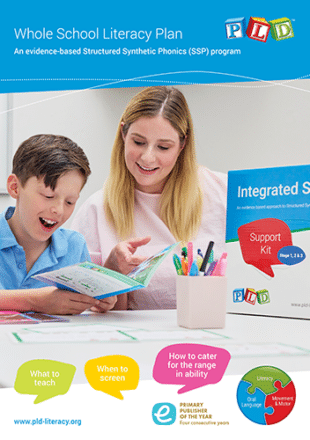
The document outlines how to implement PLD's literacy, Movement and Motor and Oral Language resources during the Early Years, Foundation, Year 1 & 2 and across Years 3 to 6. Each page provides suggested time frames and implementation recommendations.
The purpose of this document is to provide an implementation outline to assist schools in scheduling the PLD programs within a broad school-based strategy. When
A screen of comprehension ability focusing on Blank Level 1 and Level 2 questions.
The Comprehension Questions screens can be used to assess a child’s progress with the comprehension programs or to allow for the identification of areas of
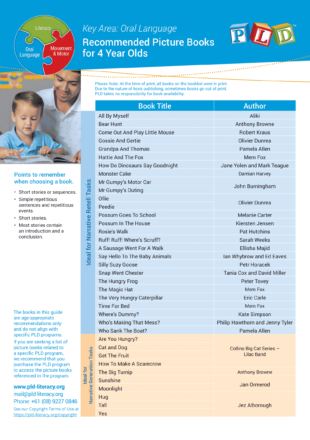
A recommended reading book list that promotes the development of oral language skills in children aged 4 years old.
The books in this guide outline quality age-appropriate recommendations only and do not align with specific PLD programs. The lists have been created by speech
Introduction to the Program
This program is designed to develop early narrative skills in young children by encouraging them to retell simple activities and events. Through structured activities, children learn to sequence events, expand their vocabulary, and improve their ability to speak in connected sentences.
The Program Includes:
Activity retell posters suitable for 3-5 year olds
Multiple activity retell templates and examples across 4 themes
Vocabulary focused on real-life categories relevant to children
Cooking
Arts and Crafts
Play
Household
Other Programs within the Range:
Picture Book Retelling – Step 1
Developing News Telling and Narrative Skills for 4 Year Olds
Links to the Teaching Sequence Manuals
This product is mentioned in the Early Years Teaching Sequence Manual
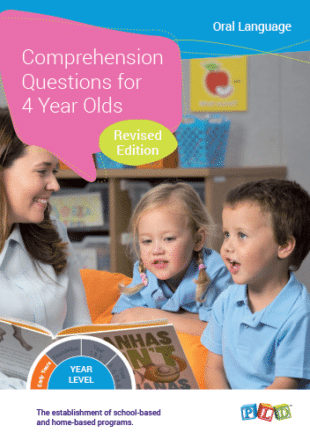
A home or school picture book program for 4 Year Old students.
Comprehension Questions for 4 Year Olds is a home or school resource designed to support oral language development in young children. From a young age, children should be verbal, actively engage in social interactions and understand simple, literal questions about their surroundings. By age 4, children begin answering more complex questions, requiring them to identify less obvious attributes, make predictions and sequence information. This program, developed by speech pathologists, supports the development of these foundational comprehension skills using engaging picture books to ask age-appropriate questions and assess oral responses. Oral language skills are critical for social interaction and academic success.
Program Includes:
Picture Book Recommendations: List of developmentally appropriate Picture Book recommendations, such as 'Piranhas Don't Eat Bananas' and 'We're Going on a Bear Hunt'.
41 Question Cards for Repeated Reading Sessions: Develop blending skills through engaging visuals.
Each card contains sample questions (over four days) and model answers based on each recommended picture book.
Questions focus on Blank Level 2 and 3 skills, such as 'What is this part used for?' or 'How did you feel?'
Instruction Booklet: Guidance for presenting in group, class or home settings.
Strategies for Success: Techniques for responding to inadequate answers.
Progress Check: Two assessments to monitor comprehension skill development.
Other Programs within the Range:
Comprehension Questions for 3 Year Old (Mc3)
Parent Training Video: 3 Year Olds
Comprehension Questions for 4 Year Old (Mc4)
Parent Training Video: 4 Year Olds
Comprehension Questions for 5 Year Old (Mc5)
Parent Training Video: 5 Year Olds
Comprehension Questions for 6 and 7 Year Old (Mc6)
Parent Training Video: 6 and 7 Year Olds
Comprehension Questions for 8 and 9 Year Old (Mc8)
Parent Training Video: 8 and 9 Year Olds
The full set of Comprehension Questions Range (Mc3/4/5/6/8)
Links to the Teaching Sequence Manuals:
This product can be used to support the implementation of the Early Years Teaching Sequence Manual on Page 5
Developing vocabulary and the ability to speak in sentences.
Introduction to the Program
This program is designed to provide quick, engaging activities that foster oral language development in young learners. Each game takes just 10 minutes, making it easy to incorporate into daily routines or classroom sessions.
The Program Includes:
6 themes, each with 3 different language games
Naming and speaking in single words
Sorting and speaking in short sentences
Describing and connecting several sentences together
Vocabulary focused on real-life categories relevant to children
Food
Things you wear
Farm animals
Things that take you places
Toys
Around the home
Activities tailored to 3-5 year old language development stages
Other Programs within the Range:
10 Minute Language Games – Set 1
10 Minute Language Games – Set 2
Links to the Teaching Sequence Manuals
This product is mentioned in the Early Years Teaching Sequence Manual
This website uses cookies to improve your experience while you navigate through the website. Out of these, the cookies that are categorized as necessary are stored on your browser as they are essential for the working of basic functionalities of the website. We also use third-party cookies that help us analyze and understand how you use this website. These cookies will be stored in your browser only with your consent. You also have the option to opt-out of these cookies. But opting out of some of these cookies may affect your browsing experience.
Necessary cookies are absolutely essential for the website to function properly. These cookies ensure basic functionalities and security features of the website, anonymously.
Cookie
Duration
Description
cookielawinfo-checkbox-analytics
11 months
This cookie is set by GDPR Cookie Consent plugin. The cookie is used to store the user consent for the cookies in the category "Analytics".
cookielawinfo-checkbox-functional
11 months
The cookie is set by GDPR cookie consent to record the user consent for the cookies in the category "Functional".
cookielawinfo-checkbox-necessary
11 months
This cookie is set by GDPR Cookie Consent plugin. The cookies is used to store the user consent for the cookies in the category "Necessary".
cookielawinfo-checkbox-others
11 months
This cookie is set by GDPR Cookie Consent plugin. The cookie is used to store the user consent for the cookies in the category "Other.
cookielawinfo-checkbox-performance
11 months
This cookie is set by GDPR Cookie Consent plugin. The cookie is used to store the user consent for the cookies in the category "Performance".
viewed_cookie_policy
11 months
The cookie is set by the GDPR Cookie Consent plugin and is used to store whether or not user has consented to the use of cookies. It does not store any personal data.
Functional cookies help to perform certain functionalities like sharing the content of the website on social media platforms, collect feedbacks, and other third-party features.
Performance cookies are used to understand and analyze the key performance indexes of the website which helps in delivering a better user experience for the visitors.
Analytical cookies are used to understand how visitors interact with the website. These cookies help provide information on metrics the number of visitors, bounce rate, traffic source, etc.
Advertisement cookies are used to provide visitors with relevant ads and marketing campaigns. These cookies track visitors across websites and collect information to provide customized ads.