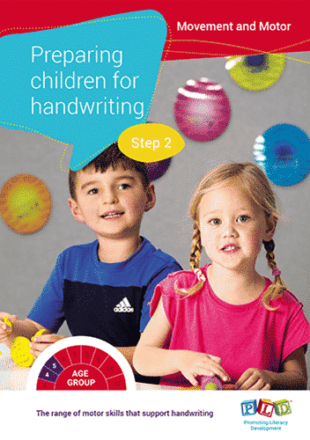
The range of motor skills that support handwriting in Early Years students.
Early childhood education is a critical time for consolidating the fine motor skills necessary for efficient pencil grasp, developing good strong habits for directionality and pre-writing skills, making sense of increasing complex visual information and storing and retaining information for future use (memory).
For this reason, we have created a 232-page Movement and Motor teaching guide to complement any early years program. The book contains clear information on developmental expectations for 4 and 5-year-olds and the foundation skills necessary for handwriting development, with a guide to handwriting readiness in addition to a wide range of activity suggestions.
Features:
Developed by an Occupational Therapist, this resource provides early childhood workers and parents with easy-to-understand information and activities focused upon fine and gross motor skill development for 3 to 4 year olds.
Contains cutting, colouring, drawing, playdough, pre-writing, along with ball, balance, eye tracking, and body control activities
Expectations, support, and guidance on pencil grip and posture, among other skills.
Preparing Children for Handwriting - Step 1 - Individual Licence
$41.25 / year(inc. $3.75 GST)
Code: Mhu4il (Individual Licence)
Year Level: Early Years
This is a PLD Individual Licence resource. By purchasing this licence, this program will be accessible as a digital flipbook that will be stored in your secure account on the PLD website and may only be accessed by an individual user, being the Purchaser.
The program will be accessible as a digital flipbook that can be accessed by the purchaser on any device for as long as the licence is active. An Individual Licence is valid for 12 months from the date of purchase.
Sharing of an Individual Licence or account credentials for the purpose of sharing an Individual Licence is a breach of Australian Copyright Law and PLD Terms of Use. For more information,
visit our Individual Licence FAQ.
The range of motor skills that support handwriting in Early Years students
Early childhood education is a critical time for consolidating the fine motor skills necessary for efficient pencil grasp, developing good strong habits for directionality and pre-writing skills, making sense of increasing complex visual information and storing and retaining information for future use (memory).
For this reason, we have created a 232-page Movement and Motor teaching guide to complement any early years program. The book contains clear information on developmental expectations for 4 and 5-year-olds and the foundation skills necessary for handwriting development, with a guide to handwriting readiness in addition to a wide range of activity suggestions.
Features:
Developed by an Occupational Therapist, this resource provides early childhood workers and parents with easy-to-understand information and activities focused upon fine and gross motor skill development for 3 to 4 year olds.
Contains cutting, colouring, drawing, playdough, pre-writing, along with ball, balance, eye tracking, and body control activities
Expectations, support, and guidance on pencil grip and posture, among other skills.
Preparing Children for Handwriting - Step 1 - School Licence
From $65.00$65.00 incl. GST / year(inc. $5.91 GST)
Code: Mhu4vs (School Licence)
Year Level: Early Years
This is a PLD Whole School Licence resource.By purchasing this licence, this program will be accessible as a digital flipbook that will be stored in your secure account on the PLD website. The program will be accessible as a digital flipbook that teachers can access on any device for as long as the licence is active. A School Licence is valid for 12 months from the date of purchase and can be shared with all staff employed at the school.We highly recommend that either the Principal, Deputy Principal or a member of the admin team purchase the School Licence in order to manage the account and its users. For more information,visit our Whole School Licence FAQ.
The range of motor skills that support handwriting in Early Years students
Early childhood education is a critical time for consolidating the fine motor skills necessary for efficient pencil grasp, developing good strong habits for directionality and pre-writing skills, making sense of increasing complex visual information and storing and retaining information for future use (memory).
For this reason, we have created a 232-page Movement and Motor teaching guide to complement any early years program. The book contains clear information on developmental expectations for 4 and 5-year-olds and the foundation skills necessary for handwriting development, with a guide to handwriting readiness in addition to a wide range of activity suggestions.
Features:
Developed by an Occupational Therapist, this resource provides early childhood workers and parents with easy-to-understand information and activities focused upon fine and gross motor skill development for 3 to 4 year olds.
Contains cutting, colouring, drawing, playdough, pre-writing, along with ball, balance, eye tracking, and body control activities
Expectations, support, and guidance on pencil grip and posture, among other skills.
Books: PLD’s books may be used by the authorised purchaser within their classroom, however there are restrictions regarding modifying, copying or sharing. Full details can be found here.
School Licences: A School Licence allows access to a resource to be shared with an unlimited number of employees who are employed by the ‘Authorised purchaser’. These resources can be accessed by multiple users simultaneously and can be printed (subject to restrictions) or displayed by employees of the ‘Authorised purchaser’ within their classroom. Learn more here.
Downloadable resources & screening tools: These resources can be viewed, downloaded, printed and shared providing the resources are not modified in any way. Learn more here.
Breaches of Australian Copyright Law are taken seriously and may result in legal action being taken. Full copyright information can be found. Learn more here.
The document outlines how to implement PLD's literacy, Movement and Motor and Oral Language resources during the Early Years, Foundation, Year 1 & 2 and across Years 3 to 6. Each page provides suggested time frames and implementation recommendations.
The purpose of this document is to provide an implementation outline to assist schools in scheduling the PLD programs within a broad school-based strategy. When
These milestone and information sheets identify the age-related milestones for hand function, pencil grip (grasp) and drawing skills in children aged 1 to 6 years. They present images of good and NOT good pencil grip and also outline hints for making a good pencil grip easier.
When children first begin to draw using crayons, pencils or brushes they use a dagger grasp. In a natural developmental sequence, they will hold the
The range of motor skills that support handwriting.
Early childhood education is a critical time for consolidating the fine motor skills necessary for efficient pencil grasp, developing good strong habits for directionality and pre-writing skills, making sense of increasing complex visual information and storing and retaining information for future use (memory).
For this reason, we have created a 232-page Movement and Motor teaching guide to complement any early years program. The book contains clear information on developmental expectations for 4.5 and 5.5 year olds and the foundation skills necessary for handwriting development, with a guide to handwriting readiness in addition to a wide range of activity suggestions.
Features:
Developed by an Occupational Therapist, this resource provides early childhood workers and parents with easy-to-understand information and activities focused upon fine and gross motor skill development for Early Years students.
Contains cutting, colouring, drawing, playdough, pre-writing, along with ball, balance, eye tracking, and body control activities.
Expectations, support, and guidance on pencil grip and posture, among other skills.
Starting your students with Preparing Children for Handwriting – Step 1 provides children with the essential preparation that is needed for letter formation. This resource is mentioned in the Foundation Teaching Sequence Manual on page 14.
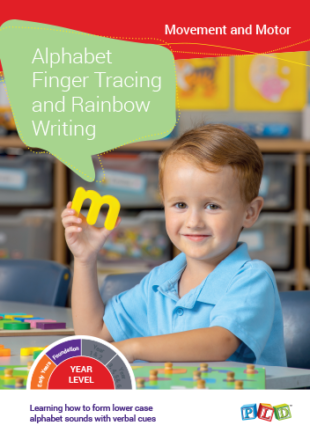
Learning how to form lower case alphabet sounds with scripted verbal ques.
Introduction to the Program
This program is designed to support early learners in developing fine motor skills and correct letter formation. Through finger tracing activities children gain confidence in writing letters while reinforcing early letter-sound relationships.
The Program Includes:
Stage 1- Target 1 alphabet sounds
Group 1: s, p, n, i, a, t
Group 2: m, r, h, e, d, c
Group 3: f, l, g, o, u b
Group 4: w, j, v, k, z, y, q, x
Multi-sensory cues to develop alphabet sound recall and formation
Verbal cues to support correct letter formation of each letter
Mouth cues for the alphabet sound
Picture cues for the alphabet sound
Other Programs within the Range:
Letter Formation for Little People – Step 1
Alphabet the Multi Sensory Way – Foundation Font
Alphabet Sound Charts – Foundation Font
Links to the Teaching Sequence Manuals
This product can be used to support the implementation of the:
Early Years Teaching Sequence Manual
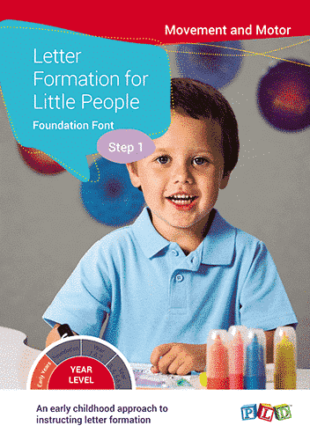
An early childhood approach to instructing letter formation in FOUNDATION FONT.
Handwriting is fundamental to literacy. Once children have mastered the essential pre-writing patterns, they are ready to start learning correct letter formation. Getting body posture right, whether in a standing or seated position, is essential prior to commencing any drawing or writing activity. This posture should also be monitored throughout the activity to ensure a child has sufficient core strength to maintain their position for the length of the task. With a stable body young children are more likely to progress to using an efficient pencil grasp, which will allow their hand to produce the movements necessary for good letter formation and handwriting. The most recent research shows that using a ‘cognitive’ approach (saying cue words out loud) incorporated with writing the actual letter, is the most effective way to learn and retain correct letter formation.
In Letter Formation for Little People – Step 1, each letter shape, with corresponding verbal cue words, is presented and learned in the same PLD groupings as the letter sounds. This will reinforce the acquisition of both of these vital skills simultaneously.
This early childhood approach, with both standing and seated activities, presents activities in four sequential levels for each letter. This developmental approach allows for differentiation between children in the classroom, with the scope to cater for a wide range of abilities. It is important that the core skills required for correct letter formation are a strong focus in the early years of schooling, to avoid the development of ‘bad habits’, such as an inefficient pencil grip, letter reversals, or incorrect direction of letters, which may affect academic progress in future years.
Letter formation and subsequently, fluent handwriting, must become an automatic skill so that the child can process their ideas as they write, without having to think about the construction of each letter they produce. Letter Formation for Little People provides a research-based program for introducing children to the early stages of handwriting, providing them with the fundamental skills they need to achieve literacy goals. Developed by an Occupational Therapist, this easy-to-use resource contains an early childhood approach to developing positive letter formation skills.
The process commences by targeting letter formation in a ‘big way’ on A3 sheets, then progresses to A4 sized letter formation before mini letters.
Each activity provides scripted instructions for the supporting adult.
Additional information on pencil grip, posture, positioning of paper etc.
Foundation Font, also available in Cursive font here
Includes:
Instruction manual (264 pages)
Step 1 has been created for use in the Early Years – Kindergarten (WA, QLD, SA, TAS) and Preschool (ACT, NT, NSW, VIC). Click here to view Step 2 for the Foundation Year – Pre-Primary (WA), Prep. (QLD, VIC, TAS), Reception (SA), Transition (NT).
This product is mentioned in the Early Years Teaching Sequence Manual on page 6 & 7.
The programs within the range include:
Letter Formation for Little People – Step 1 (for the Early Years)
Letter Formation for Little People – Step 2 (for Foundation)
Letter Formation for Little People – Step 3 (Year 1)
Letter Formation for Little People – Cursive Font
This website uses cookies to improve your experience while you navigate through the website. Out of these, the cookies that are categorized as necessary are stored on your browser as they are essential for the working of basic functionalities of the website. We also use third-party cookies that help us analyze and understand how you use this website. These cookies will be stored in your browser only with your consent. You also have the option to opt-out of these cookies. But opting out of some of these cookies may affect your browsing experience.
Necessary cookies are absolutely essential for the website to function properly. These cookies ensure basic functionalities and security features of the website, anonymously.
Cookie
Duration
Description
cookielawinfo-checkbox-analytics
11 months
This cookie is set by GDPR Cookie Consent plugin. The cookie is used to store the user consent for the cookies in the category "Analytics".
cookielawinfo-checkbox-functional
11 months
The cookie is set by GDPR cookie consent to record the user consent for the cookies in the category "Functional".
cookielawinfo-checkbox-necessary
11 months
This cookie is set by GDPR Cookie Consent plugin. The cookies is used to store the user consent for the cookies in the category "Necessary".
cookielawinfo-checkbox-others
11 months
This cookie is set by GDPR Cookie Consent plugin. The cookie is used to store the user consent for the cookies in the category "Other.
cookielawinfo-checkbox-performance
11 months
This cookie is set by GDPR Cookie Consent plugin. The cookie is used to store the user consent for the cookies in the category "Performance".
viewed_cookie_policy
11 months
The cookie is set by the GDPR Cookie Consent plugin and is used to store whether or not user has consented to the use of cookies. It does not store any personal data.
Functional cookies help to perform certain functionalities like sharing the content of the website on social media platforms, collect feedbacks, and other third-party features.
Performance cookies are used to understand and analyze the key performance indexes of the website which helps in delivering a better user experience for the visitors.
Analytical cookies are used to understand how visitors interact with the website. These cookies help provide information on metrics the number of visitors, bounce rate, traffic source, etc.
Advertisement cookies are used to provide visitors with relevant ads and marketing campaigns. These cookies track visitors across websites and collect information to provide customized ads.


 Register


 Login
Login
 (0)
(0)

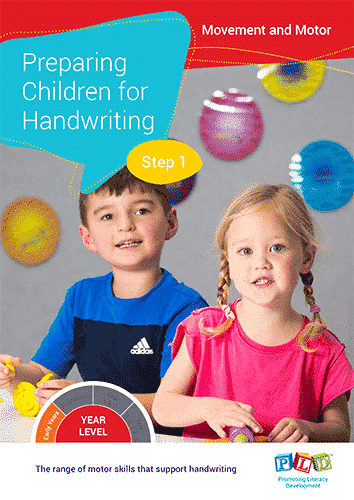
 Code: Mhu4

 Preview Book