Outlining the relationship between letters and sounds.
Introduction to the Program
This essential guide outlines the PLD approach to implementing reading and spelling instruction from Foundation to Year 6. The Program Includes:
A structured whole-school scope and sequence, outline phonic concepts, morphology, reading and spelling words, regular and irregular high-frequency words.
Termly assessments to establish the range in ability and reviewing progress.
Stages 1-3 focus on teaching essential phonic concepts and common-bound morpheme suffixes.
Stages 4-6 focus on extending alternative spellings of phonic concepts and more sophisticated word attack spelling based on syllables, prefixes, suffixes and morphemes.
Difficulty acquiring Stage 1 concept assessments to investigate slow-to-progress students.
Posters and guidelines on the explicit teaching of reading and spelling words in phonemes or syllables and irregular high-frequency words.
Phonic and Sight Word Sequence - Individual Licence
$41.25 / year(inc. $3.75 GST)
Code: Bpswil (Individual Licence)
Year Level: Foundation, Individual licence, School Licences, Year 1 & 2, Years 3 to 6
This is a PLD Individual Licence resource. By purchasing this licence, this program will be accessible as a digital flipbook that will be stored in your secure account on the PLD website and may only be accessed by an individual user, being the Purchaser.
The program will be accessible as a digital flipbook that can be accessed by the purchaser on any device for as long as the licence is active. An Individual Licence is valid for 12 months from the date of purchase.
Sharing of an Individual Licence or account credentials for the purpose of sharing an Individual Licence is a breach of Australian Copyright Law and PLD Terms of Use. For more information,
visit our Individual Licence FAQ.
Outlining the relationship between letters and sounds.
By middle and upper primary, classes typically have a huge range in ability levels. Using the placement tests in Phonic and Sight Word Sequence levels are quickly established and class specific content can be devised. This best selling resource covers Foundation all the way through to Year 6 and provides teachers and parents with:
A structured whole-school scope and sequence for primary schools, outlining phonic concepts, spelling rules, morphology, reading and spelling words, sight words and assessments.
Termly reviews are provided for establishing the range in ability, for reviewing progress and for measurable data.
Stages 1, 2 and 3 primarily outline structured synthetic phonics content along with common bound morpheme suffixes.
Stages 4, 5 and 6 are comprised of structured synthetic plus more sophisticated word attack spelling based upon syllables, prefixes, suffixes, and morphemes.
Placement tests, term reviews, and short investigations when students are slow to progress are included.
Guidelines for the explicit teaching of sight words are contained within the appendix.
To find out how the Fourth Edition differs from previous versions, click here.
From $65.00$65.00 incl. GST / year(inc. $5.91 GST)
Code: Bpswvs (School Licence)
Year Level: Foundation, Individual licence, School Licences, Year 1 & 2, Years 3 to 6
This is a PLD Whole School Licence resource.By purchasing this licence, this program will be accessible as a digital flipbook that will be stored in your secure account on the PLD website. The program will be accessible as a digital flipbook that teachers can access on any device for as long as the licence is active. A School Licence is valid for 12 months from the date of purchase and can be shared with all staff employed at the school.We highly recommend that either the Principal, Deputy Principal or a member of the admin team purchase the School Licence in order to manage the account and its users. For more information,visit our Whole School Licence FAQ.
Outlining the relationship between letters and sounds.
By middle and upper primary, classes typically have a huge range in ability levels. Using the placement tests in Phonic and Sight Word Sequence levels are quickly established and class specific content can be devised. This best selling resource covers Foundation all the way through to Year 6 and provides teachers and parents with:
A structured whole-school scope and sequence for primary schools, outlining phonic concepts, spelling rules, morphology, reading and spelling words, sight words and assessments.
Termly reviews are provided for establishing the range in ability, for reviewing progress and for measurable data.
Stages 1, 2 and 3 primarily outline structured synthetic phonics content along with common bound morpheme suffixes.
Stages 4, 5 and 6 are comprised of structured synthetic plus more sophisticated word attack spelling based upon syllables, prefixes, suffixes, and morphemes.
Placement tests, term reviews, and short investigations when students are slow to progress are included.
Guidelines for the explicit teaching of sight words are contained within the appendix.
To find out how the Fourth Edition differs from previous versions, click here.
Books: PLD’s books may be used by the authorised purchaser within their classroom, however there are restrictions regarding modifying, copying or sharing. Full details can be found here.
School Licences: A School Licence allows access to a resource to be shared with an unlimited number of employees who are employed by the ‘Authorised purchaser’. These resources can be accessed by multiple users simultaneously and can be printed (subject to restrictions) or displayed by employees of the ‘Authorised purchaser’ within their classroom. Learn more here.
Downloadable resources & screening tools: These resources can be viewed, downloaded, printed and shared providing the resources are not modified in any way. Learn more here.
Breaches of Australian Copyright Law are taken seriously and may result in legal action being taken. Full copyright information can be found. Learn more here.
The Year 3, 4, 5 & 6 Screening & Tracking Manual outlines step-by-step instructions including what and when to screen, the materials required, time allocations
The Year 1 & 2 Screening & Tracking Manual outlines step-by-step instructions including what and when to screen, the materials required, time allocations and discontinue
The Foundation Screening & Tracking Manual outlines step-by-step instructions including what and when to screen, the materials required, time allocations and discontinue rules. We recommended that
The Early Years Screening & Tracking Manual outlines step-by-step instructions including what and when to screen, the materials required, time allocations and discontinue rules. We recommended
Developing the relationship between letters, sounds and phonics.
This handy Synthetic Phonics Flip Book for Stage 2 resource is intended to provide important synthetic phonic concepts in a practical format which will assist when teaching the whole class or small groups of students. Synthetic phonics is a way of teaching children to read and spell. It has been identified as the most successful approach to establishing early literacy skills. The ‘synthetic’ component relates to the ‘synthesising’ or blending of phonemes (or individual speech sounds) and the ‘phonic’ component relates to written symbols (graphemes) being linked to the individual speech sounds (phonemes).
In order to learn how to read, a child links letters to speech sounds and then blends them together to form words. When learning to spell a child separates or segments a word into the individual speech sounds within the word while linking the sounds to letters.
Features:
Designed by speech pathologists for use in schools.
The flip book is based upon PLD’s ‘structured synthetic phonics’ (SSP) approach.
Consolidates Stage 1 concepts, before presenting stage 2 phonic sounds.
A range of reading and spelling words are provided for each alphabet and phonic sound.
Students associate a picture and keywords with each phonic concept.
An effective and engaging way to develop early phonic concepts.
The Flip Book contains the following levels:
Set 1 (Stage 1 Revision) – ck, sh, th, ch, wh, ee, oo, ing
Set 2 (Stage 1 Revision) – ai, er, or, oi, ar, ay, oy, all
Set 3 (Stage 2) – i-e, a-e, o-e, e-e, u-e
Set 4 (Stage 2) – aw, oe, ew, ou, ow, ir, ea, y, oa, ue, ie, ur
Set 5 (Tricky Graphemes) – qu, x
This resource is part of the Synthetic Phonics Flip Book range, view the other levels below:
Synthetic Phonics Flip Book – Stage 1
Synthetic Phonics Flip Book – Stage 2, 3 & 4
Synthetic Phonics three Flip Books in a bundle
This publication is mentioned within the Year 1 & 2 Teaching Sequence Manual on pages 13 – 16.
Generous discounts apply for bulk orders
5 to 9 copies – 15% discount applies
10+ copies – 20% discount applies
Synthetic phonics, vocabulary and writing activities.
The ability to read well is a basic skill and vital to national survival (Chall 1989). However, there have been ongoing concerns regarding the poor adult literacy rates since the introduction of whole language approaches to literacy development both within Australia and internationally. In 2004 these concerns led to a National Inquiry into the Teaching of Literacy (NITL) here in Australia. The results, published in 2005 recognised the importance of a systematic, synthetic phonics approach to reading instruction (Bowey 2006). These findings were independently echoed in the US and UK with recommendations that teaching of reading and spelling must include a synthetic phonics approach (Dooner 2010).
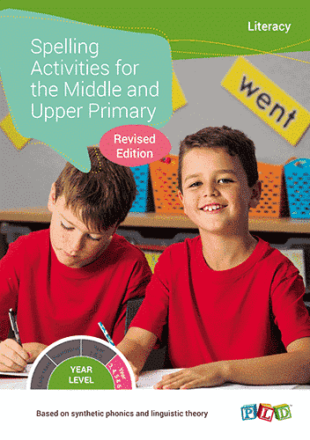
As Joshi (2009) clearly outlines, one cannot teach what one does not understand, and it is therefore important that teachers understand synthetic phonics, the alphabetic code, phonological awareness and types of language and vocabulary and how these work together in the development of strong literacy skills. Spelling Activities for the Middle and Upper Primary is intended to provide a definition of synthetic phonics and related skills, an understanding of the importance of synthetic phonics, and practical suggestions for how to teach synthetic phonics within the classroom, in addition to specific spelling activities which are based on the principles of synthetic phonics and are ready to use with your students individually, within small groups or as part of whole-class activities.
Features:
Middle and Upper Primary spelling activities resource (which incorporates synthetic phonics and linguistic theory).
Three levels of each template aim to cater for the range in ability (i.e. delayed, average and advanced students) evident in classrooms.
The activity templates are ready to photocopy.
A key resource when establishing a spelling program.
Assessment points are located at the base of each sheet (for students, a peer or teachers to rate task performance).
An ideal complement to PLD’s Phonic Sight Word Sequence.
This publication is mentioned within the Whole School Literacy Strategy booklet on page 22.
Other programs within the range include:
Spelling Activities for the Junior Primary
Spelling Activities are also available within the Time-Savers range:
Structured Synthetic Phonics Time-Savers Stage 1 & 2
Structured Synthetic Phonics Time-Savers Stage 3 & 4
Structured Synthetic Phonics Time-Savers Stage 5 & 6
Full Set of Structured Synthetic Phonics Time Savers
This website uses cookies to improve your experience while you navigate through the website. Out of these, the cookies that are categorized as necessary are stored on your browser as they are essential for the working of basic functionalities of the website. We also use third-party cookies that help us analyze and understand how you use this website. These cookies will be stored in your browser only with your consent. You also have the option to opt-out of these cookies. But opting out of some of these cookies may affect your browsing experience.
Necessary cookies are absolutely essential for the website to function properly. These cookies ensure basic functionalities and security features of the website, anonymously.
Cookie
Duration
Description
cookielawinfo-checkbox-analytics
11 months
This cookie is set by GDPR Cookie Consent plugin. The cookie is used to store the user consent for the cookies in the category "Analytics".
cookielawinfo-checkbox-functional
11 months
The cookie is set by GDPR cookie consent to record the user consent for the cookies in the category "Functional".
cookielawinfo-checkbox-necessary
11 months
This cookie is set by GDPR Cookie Consent plugin. The cookies is used to store the user consent for the cookies in the category "Necessary".
cookielawinfo-checkbox-others
11 months
This cookie is set by GDPR Cookie Consent plugin. The cookie is used to store the user consent for the cookies in the category "Other.
cookielawinfo-checkbox-performance
11 months
This cookie is set by GDPR Cookie Consent plugin. The cookie is used to store the user consent for the cookies in the category "Performance".
viewed_cookie_policy
11 months
The cookie is set by the GDPR Cookie Consent plugin and is used to store whether or not user has consented to the use of cookies. It does not store any personal data.
Functional cookies help to perform certain functionalities like sharing the content of the website on social media platforms, collect feedbacks, and other third-party features.
Performance cookies are used to understand and analyze the key performance indexes of the website which helps in delivering a better user experience for the visitors.
Analytical cookies are used to understand how visitors interact with the website. These cookies help provide information on metrics the number of visitors, bounce rate, traffic source, etc.
Advertisement cookies are used to provide visitors with relevant ads and marketing campaigns. These cookies track visitors across websites and collect information to provide customized ads.


 Login
Login Register


 (0)
(0)


 Code: Bpsw

 Preview Book