Product added to the list
DSPPc

Alphabet Desk Mats for The Early Years (Cursive Font)

$30.00 (inc. $2.73 GST)
Code: DSPPC
Year Level: Early Years
Book
Book
Alphabet support for the Early Years.

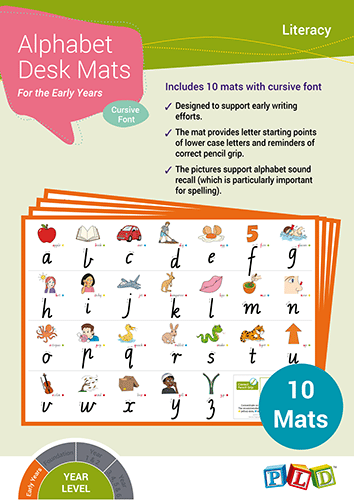
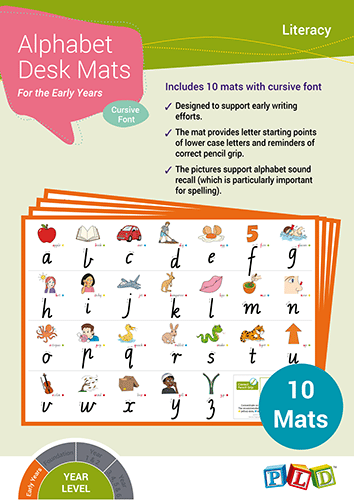
Designed by Speech Pathologists and educators, Alphabet Desk Mats have been designed for children aged 3-5 years old to support early writing efforts. They are attractive resources for use in the school or home to assist children providing:

  • Letter starting points of lower case letters
  • Reminders of correct pencil grip
  • The pictures support alphabet sound recall (which is particularly important for spelling).
  • Also available in Foundation Font available

The recommended order of letter presentation.

  • Group 1 Letters (s, a, t, p, i, n) with yellow dots
  • Group 2 Letters (m, r, h, e, c, d) with blue dots
  • Group 3 Letters (f, l, g, o, u, b) with green dots
  • Group 4 Letters (w, j, v, k, z, y q, x) with red dots

The recommended manner of presentation.

  • Introduce then revise one group at a time.
  • Only progress onto subsequent groups of letters once previous concepts covered has been demonstrated.

Includes:

  • Physical: Desk Mats (Pack Of 10)

Other Desk Strips and Mats available:

DSPPc

Alphabet Desk Mats for The Early Years (Cursive Font) - School Licence

From $22.50$22.50 incl. GST / year (inc. $2.05 GST)
Code: DSPPCvs (School Licence)
Year Level: Early Years
Book
Book

Select your school size

Extra small

(<49 students)

Small

(50-149 students)

Medium

(150-349 students)

Large

(350+ students)

Add to quote

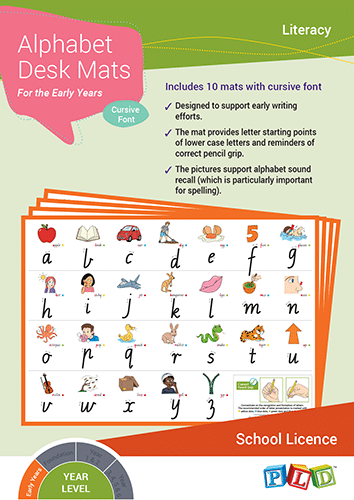
Designed by Speech Pathologists and educators, Alphabet Desk Mats have been designed for children aged 3-5 years old to support early writing efforts. They are attractive resources for use in the school or home to assist children providing:

  • Letter starting points of lower case letters
  • Reminders of correct pencil grip
  • The pictures support alphabet sound recall (which is particularly important for spelling).
  • Also available in Foundation Font available

The recommended order of letter presentation.

  • Group 1 Letters (s, a, t, p, i, n) with yellow dots
  • Group 2 Letters (m, r, h, e, c, d) with blue dots
  • Group 3 Letters (f, l, g, o, u, b) with green dots
  • Group 4 Letters (w, j, v, k, z, y q, x) with red dots

The recommended manner of presentation.

  • Introduce then revise one group at a time.
  • Only progress onto subsequent groups of letters once previous concepts covered has been demonstrated.

Includes:

  • Physical: Desk Mats (Pack Of 10)

Other Desk Strips and Mats available:

DSPPc

Alphabet Desk Mats for The Early Years (Cursive Font) -Individual Licence

$15.00 / year (inc. $1.36 GST)
Code: DSPPCil (Individual Licence)
Year Level: Early Years
Book
Book
Add to quote

This is a PLD Individual Licence resource. By purchasing this licence, this program will be accessible as a digital flipbook that will be stored in your secure account on the PLD website and may only be accessed by an individual user, being the Purchaser. The program will be accessible as a digital flipbook that can be accessed by the purchaser on any device for as long as the licence is active. An Individual Licence is valid for 12 months from the date of purchase. Sharing of an Individual Licence or account credentials for the purpose of sharing an Individual Licence is a breach of Australian Copyright Law and PLD Terms of Use. For more information, visit our Individual Licence FAQ.

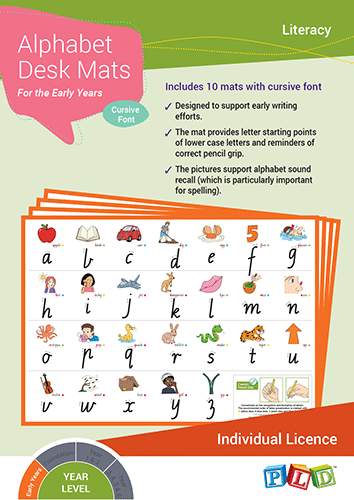
Designed by Speech Pathologists and educators, Alphabet Desk Mats have been designed for children aged 3-5 years old to support early writing efforts. They are attractive resources for use in the school or home to assist children providing:

  • Letter starting points of lower case letters
  • Reminders of correct pencil grip
  • The pictures support alphabet sound recall (which is particularly important for spelling).
  • Also available in Foundation Font available

The recommended order of letter presentation.

  • Group 1 Letters (s, a, t, p, i, n) with yellow dots
  • Group 2 Letters (m, r, h, e, c, d) with blue dots
  • Group 3 Letters (f, l, g, o, u, b) with green dots
  • Group 4 Letters (w, j, v, k, z, y q, x) with red dots

The recommended manner of presentation.

  • Introduce then revise one group at a time.
  • Only progress onto subsequent groups of letters once previous concepts covered has been demonstrated.

Includes:

  • Physical: Desk Mats (Pack Of 10)

Other Desk Strips and Mats available:

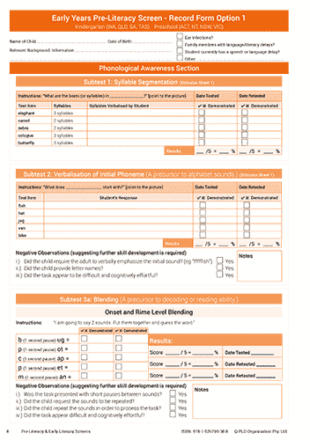
  • Early Years Pre-Literacy Screening
    Early Years Pre-Literacy Screening
    The Pre-Literacy Screens have been designed to profile the acquisition of core literacy precursor skills that will impact later reading, spelling and phonic development.

    The screen focuses on two main skills: 1. Phonological Awareness: the ability to attend to the phonological structure or sound structure of words. 2. Alphabetic

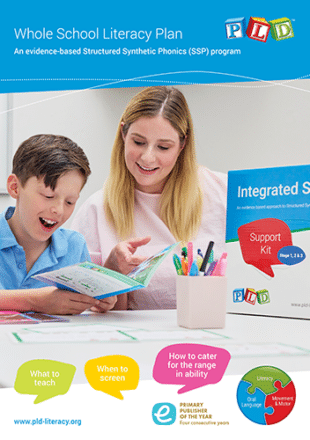
  • PLD's Whole School Literacy Plan
    PLD’s Whole School Literacy Plan
    The document outlines how to implement PLD's literacy, Movement and Motor and Oral Language resources during the Early Years, Foundation, Year 1 & 2 and across Years 3 to 6. Each page provides suggested time frames and implementation recommendations.

    The purpose of this document is to provide an implementation outline to assist schools in scheduling the PLD programs within a broad school-based strategy. When

  • Early Years Language, Literacy & Motor Developmental Milestones
    Private: Early Years Language, Literacy & Motor Developmental Milestones
    A booklet that provides an overview of Oral Language, Literacy and Motor for children in the early years (3 and 4 year olds). Tips for home and causes for concern are also outlined. The booklet can be photocopied back to back and then folded in half to provide a compact reference.

    Three and four year olds approach the world with great curiosity and a desire to explore. As a result, this age range is considered to

  • Speak A3 poster
    Speak A3 poster
    To Create A Good Speaking And Listening Environment

    Brainstorm with students what makes a good listener and speaker. Have a reward system that promotes good listening and speaking behaviours in the classroom. Give

People who viewed this also viewed...

  • Letter Formation for Little People – Foundation Font – Step 2
    Letter Formation for Little People - Foundation Font - Step 2
    A junior primary approach to instructing letter formation in FOUNDATION FONT.

    Handwriting is fundamental to literacy. Once children have mastered the essential pre-writing patterns, they are ready to start learning correct letter formation. Getting body posture right, whether in a standing or seated position, is essential prior to commencing any drawing or writing activity. This posture should also be monitored throughout the activity to ensure a child has sufficient core strength to maintain their position for the length of the task. With a stable body young children are more likely to progress to using an efficient pencil grasp, which will allow their hand to produce the movements necessary for good letter formation and handwriting. The most recent research shows that using a ‘cognitive’ approach (saying cue words out loud) incorporated with writing the actual letter, is the most effective way to learn and retain correct letter formation. In Letter Formation for Little People – Step 2, each letter shape, with corresponding verbal cue words, is presented and learned in the same PLD groupings as the letter sounds. This will reinforce the acquisition of both of these vital skills simultaneously. This early childhood approach, with both standing and seated activities, presents activities in four sequential levels for each letter. This developmental approach allows for differentiation between children in the classroom, with the scope to cater for a wide range of abilities. It is important that the core skills required for correct letter formation are a strong focus in the early years of schooling, to avoid the development of ‘bad habits’, such as an inefficient pencil grip, letter reversals, or incorrect direction of letters, which may affect academic progress in future years. Letter formation and subsequently, fluent handwriting, must become an automatic skill so that the child can process their ideas as they write, without having to think about the construction of each letter they produce. Letter Formation for Little People provides a research-based program for introducing children to the early stages of handwriting, providing them with the fundamental skills they need to achieve literacy goals. Developed by an Occupational Therapist, this easy-to-use resource contains an early childhood approach to developing positive letter formation skills. Designed by an Occupational Therapist. Provides clear guidelines on getting ready for writing, correct pencil grip and posture. Provides multiple opportunities to rehearse letter recognition and formation skills. Provides verbal cues for each lower case letter. Also includes upper case and number formation prompts and verbal cues. Provides new verbal cues to use when introducing line placement of letters. Foundation Font Step 2 has been created for use in the Foundation Year – Pre-primary (WA), Prep. (QLD, VIC, TAS), Reception (SA), Transition (SA). Click HERE to view Step 1 for the Early Years – Kindergarten (WA, QLD, SA, TAS) and Preschool (ACT, NT, NSW, VIC). This resource is mentioned in the Foundation Teaching Sequence Manual on page 7, 8, 9, 10 & 14. The programs within the range include: Letter Formation for Little People – Step 1 (for the Early Years) Letter Formation for Little People – Step 2 (for Foundation) Letter Formation for Little People – Step 3 (Year 1) Letter Formation for Little People – Cursive Font

    $82.50$82.50 incl. GST
  • Letter Formation for Little People – Foundation Font – Step 1
    Letter Formation for Little People - Foundation Font - Step 1
    An early childhood approach to instructing letter formation in FOUNDATION FONT.

    Handwriting is fundamental to literacy. Once children have mastered the essential pre-writing patterns, they are ready to start learning correct letter formation. Getting body posture right, whether in a standing or seated position, is essential prior to commencing any drawing or writing activity. This posture should also be monitored throughout the activity to ensure a child has sufficient core strength to maintain their position for the length of the task. With a stable body young children are more likely to progress to using an efficient pencil grasp, which will allow their hand to produce the movements necessary for good letter formation and handwriting. The most recent research shows that using a ‘cognitive’ approach (saying cue words out loud) incorporated with writing the actual letter, is the most effective way to learn and retain correct letter formation.   In Letter Formation for Little People – Step 1, each letter shape, with corresponding verbal cue words, is presented and learned in the same PLD groupings as the letter sounds. This will reinforce the acquisition of both of these vital skills simultaneously.   This early childhood approach, with both standing and seated activities, presents activities in four sequential levels for each letter. This developmental approach allows for differentiation between children in the classroom, with the scope to cater for a wide range of abilities. It is important that the core skills required for correct letter formation are a strong focus in the early years of schooling, to avoid the development of ‘bad habits’, such as an inefficient pencil grip, letter reversals, or incorrect direction of letters, which may affect academic progress in future years.   Letter formation and subsequently, fluent handwriting, must become an automatic skill so that the child can process their ideas as they write, without having to think about the construction of each letter they produce. Letter Formation for Little People provides a research-based program for introducing children to the early stages of handwriting, providing them with the fundamental skills they need to achieve literacy goals. Developed by an Occupational Therapist, this easy-to-use resource contains an early childhood approach to developing positive letter formation skills. The process commences by targeting letter formation in a ‘big way’ on A3 sheets, then progresses to A4 sized letter formation before mini letters. Each activity provides scripted instructions for the supporting adult. Additional information on pencil grip, posture, positioning of paper etc. Foundation Font, also available in Cursive font here   Includes: Instruction manual (264 pages)   Step 1 has been created for use in the Early Years – Kindergarten (WA, QLD, SA, TAS) and Preschool (ACT, NT, NSW, VIC). Click here to view Step 2 for the Foundation Year – Pre-Primary (WA), Prep. (QLD, VIC, TAS), Reception (SA), Transition (NT). This product is mentioned in the Early Years Teaching Sequence Manual on page 6 & 7. The programs within the range include: Letter Formation for Little People – Step 1 (for the Early Years) Letter Formation for Little People – Step 2 (for Foundation) Letter Formation for Little People – Step 3 (Year 1) Letter Formation for Little People – Cursive Font

    $82.50$82.50 incl. GST
  • Alphabet the Multi Sensory Way – Foundation Font
    Alphabet the Multi Sensory Way - Foundation Font
    A program for 4-6 year olds, incorporating Stage 1 phonic concepts.

    Introduction to the Program An A5 flipbook utilising a multi-sensory approach to help early readers master Stage 1 phonic concepts. By engaging visual, auditory, and tactile sense, children build a strong foundation in letter recognition, formation, and sound association. The Program Includes: Stage 1 – Target 1 alphabet sounds Group 1: s, p, n, i, a, t Group 2: m, r, h, e, d, c Group 3: f, l, g, o, u b Group 4: w, j, v, k, z, y, q, x Stage 1 – Target 2 phonic concepts ‘th’ (voiced) & ‘th’ (voiceless); ‘sh’; ‘ch’; ‘ee’; ‘oo’ (long) & ‘oo’ (short); ‘ck’ Stage 1 – Target 4 phonic concepts ‘ng’; ‘ay’; ‘or’; ‘ar’; ‘ai’; al(l)’; ‘wh’; ‘qu’; ‘qu’ Multi-sensory cues to develop alphabet sound recall and formation Mnemonic letter sound pictures Verbal cues to support the correct letter formation of each letter Mouth cues for the alphabet sound Picture cues for the alphabet sound Initial teaching cards with multisensory cues and consolidation teaching cards without cues. Other Programs within the Range: Alphabet the Multi Sensory Way – Cursive Font Pre-literacy Flip Book Bundle Phonic Sound Wall Charts for Foundation Letter Formation for Little People – Step 1 Links to the Teaching Sequence Manuals This product can be used to support the implementation of the: Early Years Teaching Sequence Manual Foundation Year Teach Sequence Manual Year 1 and 2 Teaching Sequence Manual

    $75.00$75.00 incl. GST