SWCf

Phonic Sound Wall Charts for Foundation

$55.00 (inc. $5.00 GST)
Code: SWCf
Year Level: Foundation, Individual licence
Book
Book
A multi-sensory approach to learning phonics through listening, seeing, and saying.

What are the features of PLD’s Sound Wall Charts?

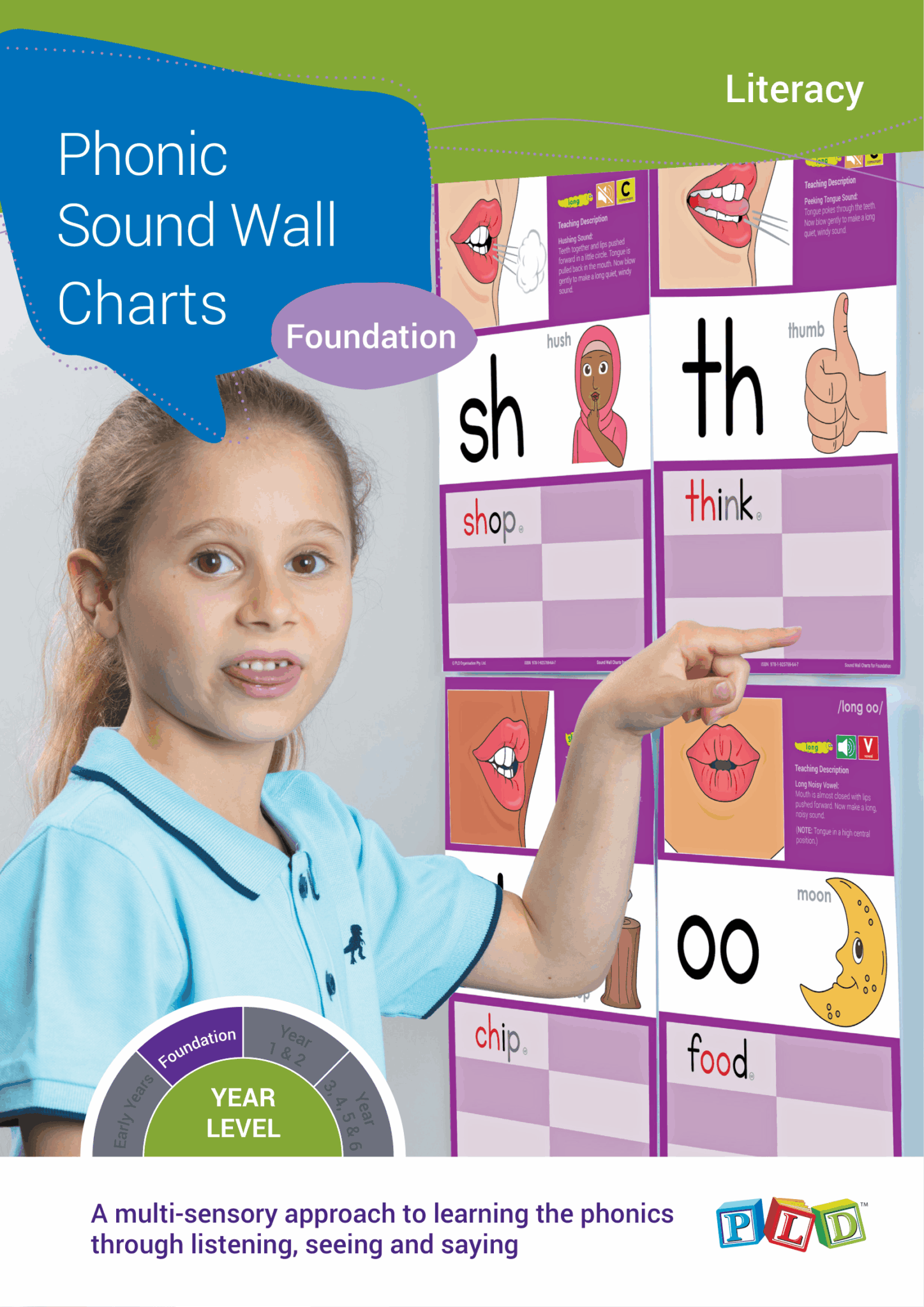
Teaching the 44 speech sounds of the English language requires accurate modelling and articulation, pedagogy that sound walls support. The PLD sound wall charts focus on the phonemes (or individual sounds) of speech and link to the PLD scheduled phonic sequence. Each phoneme-specific chart features:

  • Charts focused upon the phonemes and phonics for a Foundation class.
  • The corresponding visual of a mouth.
  • A simple description (e.g. tongue tapping sound, lip popping sound, peeking tongue sound, coughing or huffing sound)
  • A detailed description.
  • Icons identifying if the phoneme is a long or short, quiet or noisy, or vowel or consonant sound.
  • Areas to add words (making the charts interactive rather than static).
  • The related phonic concepts for each year level.

What is a sound wall display?

A sound wall is an interactive display of phonic concepts and words that is organised by and/or emphasises individual sounds (phonemes). Commonly there is one wall for consonants and one for vowels.

Sound walls focus on the formation of phonemes which gives young students a structure that helps them understand the foundation of language and written literacy. As we know from current research about the science of reading, children learn to read through the application of orthographic mapping, a speech-to-print process where letters are mapped to known speech sounds. Teachers need to harness this modern understanding by using sound wall displays as a teaching and learning tool in their classrooms to support the process of learning to read and spell.

Other Sound Wall Charts:

Recommended Reading:

SWCf

Phonic Sound Wall Charts for Foundation - Individual Licence

$27.50 / year (inc. $2.50 GST)
Code: SWCfil (Individual Licence)
Year Level: Foundation, Individual licence
Book
Book
Add to quote

This is a PLD Individual Licence resource. By purchasing this licence, this program will be accessible as a digital flipbook that will be stored in your secure account on the PLD website and may only be accessed by an individual user, being the Purchaser. The program will be accessible as a digital flipbook that can be accessed by the purchaser on any device for as long as the licence is active. An Individual Licence is valid for 12 months from the date of purchase. Sharing of an Individual Licence or account credentials for the purpose of sharing an Individual Licence is a breach of Australian Copyright Law and PLD Terms of Use. For more information, visit our Individual Licence FAQ.

A multi-sensory approach to learning alphabet sounds through listening, seeing and saying.

What are the features of PLD’s Sound Wall Charts?

Teaching the 44 speech sounds of the English language requires accurate modelling and articulation, pedagogy that sound walls support. The PLD sound wall charts focus on the phonemes (or individual sounds) of speech and link to the PLD scheduled phonic sequence. Each phoneme-specific chart features:

  • Charts focused upon the phonemes and phonics for an Early Years class.
  • The corresponding visual of a mouth.
  • A simple description (e.g. tongue tapping sound, lip popping sound, peeking tongue sound, coughing or huffing sound)
  • A detailed description.
  • Icons identifying if the phoneme is a long or short, quiet or noisy, or vowel or consonant sound.
  • Areas to add words (making the charts interactive rather than static).
  • The related phonic concepts for each year level.

What is a sound wall display?

A sound wall is an interactive display of phonic concepts and words that is organised by and/or emphasises individual sounds (phonemes). Commonly there is one wall for consonants and one for vowels.

Sound walls focus on the formation of phonemes which gives young students a structure that helps them understand the foundation of language and written literacy. As we know from current research about the science of reading, children learn to read through the application of orthographic mapping, a speech-to-print process where letters are mapped to known speech sounds. Teachers need to harness this modern understanding by using sound wall displays as a teaching and learning tool in their classrooms to support the process of learning to read and spell.


Other Sound Wall Charts Pack:

SWCf

Phonic Sound Wall Charts for Foundation - School Licence

From $45.00$45.00 incl. GST / year (inc. $4.09 GST)
Code: SWCfvs (School Licence)
Year Level: Foundation, Individual licence
Book
Book

Select your school size

Extra small

(<49 students)

Small

(50-149 students)

Medium

(150-349 students)

Large

(350+ students)

Add to quote

This is a PLD School Licence resource By purchasing this licence, this program will be accessible as a digital flipbook that will be stored in your secure account on the PLD website. The program will be accessible as a digital flipbook that teachers can access on any device for as long as the licence is active. A School Licence is valid for 12 months from the date of purchase and can be shared with all staff employed at the school. We highly recommend that either the Principal, Deputy Principal or a member of the admin team purchase the School Licence in order to manage the account and its users. For more information, visit our School Licence FAQ.

A multi-sensory approach to learning alphabet sounds through listening, seeing and saying.

What are the features of PLD’s Sound Wall Charts?

Teaching the 44 speech sounds of the English language requires accurate modelling and articulation, pedagogy that sound walls support. The PLD sound wall charts focus on the phonemes (or individual sounds) of speech and link to the PLD scheduled phonic sequence. Each phoneme-specific chart features:

  • Charts focused upon the phonemes and phonics for an Early Years class.
  • The corresponding visual of a mouth.
  • A simple description (e.g. tongue tapping sound, lip popping sound, peeking tongue sound, coughing or huffing sound)
  • A detailed description.
  • Icons identifying if the phoneme is a long or short, quiet or noisy, or vowel or consonant sound.
  • Areas to add words (making the charts interactive rather than static).
  • The related phonic concepts for each year level.

What is a sound wall display?

A sound wall is an interactive display of phonic concepts and words that is organised by and/or emphasises individual sounds (phonemes). Commonly there is one wall for consonants and one for vowels.

Sound walls focus on the formation of phonemes which gives young students a structure that helps them understand the foundation of language and written literacy. As we know from current research about the science of reading, children learn to read through the application of orthographic mapping, a speech-to-print process where letters are mapped to known speech sounds. Teachers need to harness this modern understanding by using sound wall displays as a teaching and learning tool in their classrooms to support the process of learning to read and spell.


Other Sound Wall Charts Pack:

ISBN : 9 781925 769647
  • Foundation Parent Education Sheets and Downloads - Semester 2
    Foundation Parent Education Sheets and Downloads – Semester 2

    This booklet outlines key information to be provided to parents, caregivers and the wider community within semester one. Children benefit when home and school work

  • Foundation Parent Education Sheets and Downloads - Semester 1
    Foundation Parent Education Sheets and Downloads – Semester 1

    This booklet outlines key information to be provided to parents, caregivers and the wider community within semester one. Children benefit when home and school work

  • Foundation Teaching Sequence Manual
    Foundation Teaching Sequence Manual

    The Foundation Teaching Sequence Manual outlines what to teach and when to teach it sequence over a full year for Literacy, Oral Language and Movement

  • Foundation Screening & Tracking Manual
    Foundation Screening & Tracking Manual

    The Foundation Screening & Tracking Manual outlines step-by-step instructions including what and when to screen, the materials required, time allocations and discontinue rules. We recommended that

People who viewed this also viewed...

  • Phonic Sound Wall Charts for Early Years
    Phonic Sound Wall Charts for Early Years

    What are the features of PLD’s Sound Wall Charts? Teaching the 44 speech sounds of the English language requires accurate modelling and articulation, pedagogy that sound walls support. The PLD sound wall charts focus on the phonemes (or individual sounds) of speech and link to the PLD scheduled phonic sequence. Each phoneme-specific chart features: Charts focused upon the phonemes and phonics for an Early Years class. The corresponding visual of a mouth. A simple description (e.g. tongue tapping sound, lip popping sound, peeking tongue sound, coughing or huffing sound) A detailed description. Icons identifying if the phoneme is a long or short, quiet or noisy, or vowel or consonant sound. Areas to add words (making the charts interactive rather than static). The related phonic concepts for each year level. What is a sound wall display? A sound wall is an interactive display of phonic concepts and words that is organised by and/or emphasises individual sounds (phonemes). Commonly there is one wall for consonants and one for vowels. Sound walls focus on the formation of phonemes which gives young students a structure that helps them understand the foundation of language and written literacy. As we know from current research about the science of reading, children learn to read through the application of orthographic mapping, a speech-to-print process where letters are mapped to known speech sounds. Teachers need to harness this modern understanding by using sound wall displays as a teaching and learning tool in their classrooms to support the process of learning to read and spell. Other Sound Wall Charts: Phonic Sound Wall Charts for the Early Years (26 A4 coloured charts which focus on the alphabet) Phonic Sound Wall Charts for Foundation (42 A4 coloured charts which focus on the alphabet and Stage 1 digraphs) Phonic Sound Wall Charts for Year 1 (49 A4 coloured charts which focus on Stage 1 & Stage 2 digraphs) Phonic Sound Wall Charts for Year 2 & 3 (71 A4 coloured charts which focus on Stage 1, Stage 2 & Stage 3 digraphs) Full Set of Phonic Sound Wall Charts Recommended Reading: Tips for Getting the Most Out of Sound Wall Charts Sound Walls & Structured Synthetic Phonics Programs

    $55.00$55.00 incl. GST
  • Synthetic Phonics Flip Book – Stage 1
    Synthetic Phonics Flip Book - Stage 1
    Developing the relationship between letters, sounds and phonics. 

    This handy Synthetic Phonics Flip Book for Stage 1 resource is intended to provide important synthetic phonic concepts in a practical format which will assist when teaching the whole class or small groups of students. Synthetic phonics is a way of teaching children to read and spell. It has been identified as the most successful approach to establishing early literacy skills. The ‘synthetic’ component relates to the ‘synthesising’ or blending of phonemes (or individual speech sounds) and the ‘phonic’ component relates to written symbols (graphemes) being linked to the individual speech sounds (phonemes). In order to learn how to read, a child links letters to speech sounds and then blends them together to form words. When learning to spell a child separates or segments a word into the individual speech sounds within the word while linking the sounds to letters. It is generally agreed that there are approximately 44 sounds that make up the English language. As there are only 26 letters in the alphabet some letters need to be combined to represent the remaining speech sounds. Features: Designed by speech pathologists for use in schools. The flip book is based upon PLD’s ‘structured synthetic phonics’ (SSP) approach. Early phonic concepts are introduced in a progressive manner. A range of reading and spelling words are provided for each alphabet and phonic sound. Students associate a picture, and keywords with each phonic concept. An effective and engaging way to develop early phonic concepts. The Flip Book contains the following levels: Group 1 – s, a, t, p, i, n (cards with yellow borders) Group 2 – m, r, h, e, d, c (cards with blue borders) Group 3 – f, l, g, o, u, b (cards with green borders) Group 4 – w, j, v, k, z, y, x (cards with red borders) Group 5 – sh, ch, th, oo, ee, ch, wh, qu (cards with purple borders) Group 6 – ar, or, ay, ai, er, oi, oy, ing (cards with orange borders) This resource is part of the Synthetic Phonics Flip Book range, view the other levels below: Synthetic Phonics Flip Book – Stage 1 & 2 Synthetic Phonics Flip Book – Stage 2, 3 & 4 Synthetic Phonics three Flip Books in a bundle This publication is mentioned within the Year 1 & 2 Teaching Sequence Manual on pages 9 – 13. Generous discounts apply for bulk orders 5 to 9 copies – 15% discount applies 10+ copies – 20% discount applies

    $75.00$75.00 incl. GST
  • Learning to Segment CVC Words
    Learning to Segment CVC Words
    Phonemic Awareness Segmentation Program: Preparing Children for Spelling

    Learning to Segment CVC Words is a phonemic awareness program designed to prepare children for spelling. Segmentation is the ability to break words into individual sounds. For example, peg = p/e/g. It is a critical pre-requisite for spelling simple, regular CVC words such as; tap, sun and log . This program provides engaging, structured activities to develop segmentation skills through short, explicit sessions. It supports early literacy success and can be used as part of a preventative or intervention strategy, when combined with PLD&apos;s screening tools. Program Includes: A5 Flip Book: Spiral-bound, full colour and no preparation required. Over 40 Picture Cards: Develop segmentation skills through engaging visuals. Scripted Instructions: Clear, ready-to-use guidance for teaching segmenting. Progress Check: Assess readiness for spelling and track skill development. Implementation: Use for 2-3 minutes, several times daily. Other Programs within the Range: Learning to Blend Onset and Rime Learning to Blend Three Phonemes Pre-literacy Flip Book Bundle Links to the Teaching Sequence Manuals: This product can be used to support the implementation of the Foundation Year Teaching Sequence Manual This product can be used to support the implementation of the Year 1 and 2 Teaching Sequence Manual for students working within Tier 2 and Tier 3.

    $75.00$75.00 incl. GST