Throughout the Early Years, children are encouraged to participate in a range of fine motor activities that develop:
their manipulative skills
a dominant hand
the ability to use both hands together
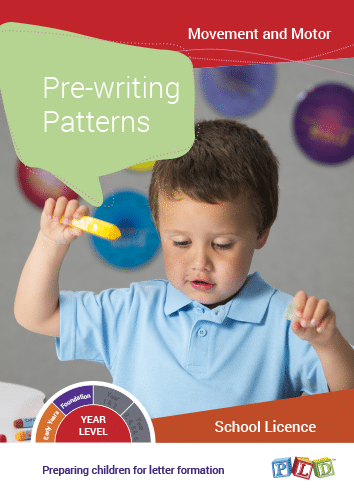
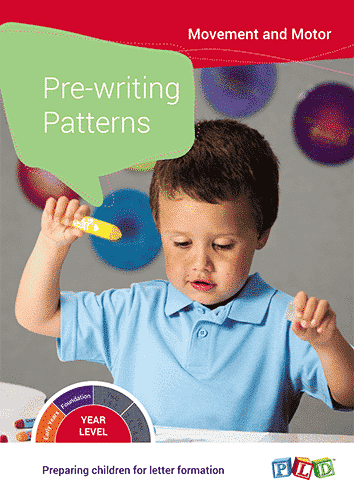
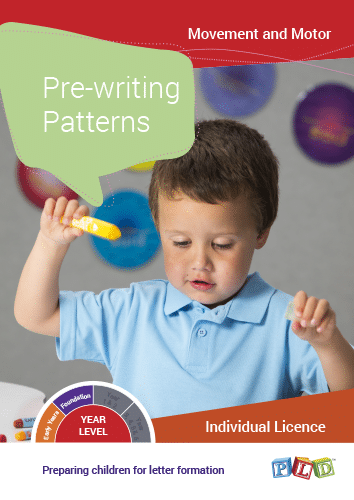
Introducing Pre-writing Patterns for 3 to 5 year olds which aids the smooth transition to writing alphabet letters. Pre-writing patterns presents a simple, systematic and fun approach for teaching the foundation skills that are necessary for fluent handwriting. This resource for parents and teachers provides information on posture, grasps, pencil control and pre-writing patterns. The manual outlines big body movements, art activities and pre-writing pattern worksheets. It outlines six basic movements that are essential for children to learn the pre-writing patterns used to make pictures and then combined to make letters and numbers.
The six basic patterns that form the basis of all alphabet letters are:
This is a PLD Individual Licence resource. By purchasing this licence, this program will be accessible as a digital flipbook that will be stored in your secure account on the PLD website and may only be accessed by an individual user, being the Purchaser.
The program will be accessible as a digital flipbook that can be accessed by the purchaser on any device for as long as the licence is active. An Individual Licence is valid for 12 months from the date of purchase.
Sharing of an Individual Licence or account credentials for the purpose of sharing an Individual Licence is a breach of Australian Copyright Law and PLD Terms of Use. For more information,
visit our Individual Licence FAQ.
Preparing children for letter formation
Throughout the Early Years, children are encouraged to participate in a range of fine motor activities that develop:
their manipulative skills
a dominant hand
the ability to use both hands together
Introducing Pre-writing Patterns for 3 to 5 year olds which aids the smooth transition to writing alphabet letters. Pre-writing patterns presents a simple, systematic and fun approach for teaching the foundation skills that are necessary for fluent handwriting. This resource for parents and teachers provides information on posture, grasps, pencil control and pre-writing patterns. The manual outlines big body movements, art activities and pre-writing pattern worksheets. It outlines six basic movements that are essential for children to learn the pre-writing patterns used to make pictures and then combined to make letters and numbers.
The six basic patterns that form the basis of all alphabet letters are:
This is a PLD Whole School Licence resource.By purchasing this licence, this program will be accessible as a digital flipbook that will be stored in your secure account on the PLD website. The program will be accessible as a digital flipbook that teachers can access on any device for as long as the licence is active. A School Licence is valid for 12 months from the date of purchase and can be shared with all staff employed at the school.We highly recommend that either the Principal, Deputy Principal or a member of the admin team purchase the School Licence in order to manage the account and its users. For more information,visit our Whole School Licence FAQ.
Preparing children for letter formation
Throughout the Early Years, children are encouraged to participate in a range of fine motor activities that develop:
their manipulative skills
a dominant hand
the ability to use both hands together
Introducing Pre-writing Patterns for 3 to 5 year olds which aids the smooth transition to writing alphabet letters. Pre-writing patterns presents a simple, systematic and fun approach for teaching the foundation skills that are necessary for fluent handwriting. This resource for parents and teachers provides information on posture, grasps, pencil control and pre-writing patterns. The manual outlines big body movements, art activities and pre-writing pattern worksheets. It outlines six basic movements that are essential for children to learn the pre-writing patterns used to make pictures and then combined to make letters and numbers.
The six basic patterns that form the basis of all alphabet letters are:
Books: PLD’s books may be used by the authorised purchaser within their classroom, however there are restrictions regarding modifying, copying or sharing. Full details can be found here.
School Licences: A School Licence allows access to a resource to be shared with an unlimited number of employees who are employed by the ‘Authorised purchaser’. These resources can be accessed by multiple users simultaneously and can be printed (subject to restrictions) or displayed by employees of the ‘Authorised purchaser’ within their classroom. Learn more here.
Downloadable resources & screening tools: These resources can be viewed, downloaded, printed and shared providing the resources are not modified in any way. Learn more here.
Breaches of Australian Copyright Law are taken seriously and may result in legal action being taken. Full copyright information can be found. Learn more here.
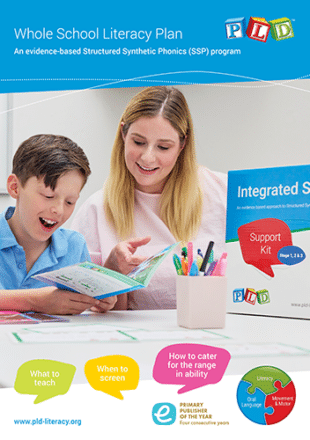
The document outlines how to implement PLD's literacy, Movement and Motor and Oral Language resources during the Early Years, Foundation, Year 1 & 2 and across Years 3 to 6. Each page provides suggested time frames and implementation recommendations.
The purpose of this document is to provide an implementation outline to assist schools in scheduling the PLD programs within a broad school-based strategy. When
These milestone and information sheets identify the age-related milestones for hand function, pencil grip (grasp) and drawing skills in children aged 1 to 6 years. They present images of good and NOT good pencil grip and also outline hints for making a good pencil grip easier.
When children first begin to draw using crayons, pencils or brushes they use a dagger grasp. In a natural developmental sequence, they will hold the
The range of motor skills that support handwriting.
Early childhood education is a critical time for consolidating the fine motor skills necessary for efficient pencil grasp, developing good strong habits for directionality and pre-writing skills, making sense of increasing complex visual information and storing and retaining information for future use (memory).
For this reason, we have created a 232-page Movement and Motor teaching guide to complement any early years program. The book contains clear information on developmental expectations for 4.5 and 5.5 year olds and the foundation skills necessary for handwriting development, with a guide to handwriting readiness in addition to a wide range of activity suggestions.
Features:
Developed by an Occupational Therapist, this resource provides early childhood workers and parents with easy-to-understand information and activities focused upon fine and gross motor skill development for Early Years students.
Contains cutting, colouring, drawing, playdough, pre-writing, along with ball, balance, eye tracking, and body control activities.
Expectations, support, and guidance on pencil grip and posture, among other skills.
Starting your students with Preparing Children for Handwriting – Step 1 provides children with the essential preparation that is needed for letter formation. This resource is mentioned in the Foundation Teaching Sequence Manual on page 14.
The range of motor skills that support handwriting in Early Years students.
Early childhood education is a critical time for consolidating the fine motor skills necessary for efficient pencil grasp, developing good strong habits for directionality and pre-writing skills, making sense of increasing complex visual information and storing and retaining information for future use (memory).
For this reason, we have created a 232-page Movement and Motor teaching guide to complement any early years program. The book contains clear information on developmental expectations for 4 and 5-year-olds and the foundation skills necessary for handwriting development, with a guide to handwriting readiness in addition to a wide range of activity suggestions.
Features:
Developed by an Occupational Therapist, this resource provides early childhood workers and parents with easy-to-understand information and activities focused upon fine and gross motor skill development for 3 to 4 year olds.
Contains cutting, colouring, drawing, playdough, pre-writing, along with ball, balance, eye tracking, and body control activities
Expectations, support, and guidance on pencil grip and posture, among other skills.
Following Step 1 with Preparing Children for Handwriting – Step 2 provides children with the essential preparation that is needed for letter formation. This product is mentioned in the Early Years Teaching Sequence Manual on page 10.
Throughout the Early Years, children are encouraged to participate in a range of fine motor activities that develop:
their manipulative skills
a dominant hand
the ability to use both hands together
Introducing Pre-writing Patterns for 3 to 5 year olds which aids the smooth transition to writing alphabet letters. Pre-writing patterns presents a simple, systematic and fun approach for teaching the foundation skills that are necessary for fluent handwriting. This resource for parents and teachers provides information on posture, grasps, pencil control and pre-writing patterns. The manual outlines big body movements, art activities and pre-writing pattern worksheets. It outlines six basic movements that are essential for children to learn the pre-writing patterns used to make pictures and then combined to make letters and numbers.
The six basic patterns that form the basis of all alphabet letters are:
Sideways, sideways left to right.
Tall lines and short lines.
Zig Zags.
Circles, drawn forwards and backward.
Up and overs.
Down and unders. Down, back and unders.
This product is mentioned in the Early Years Teaching Sequence Manual on page 4 & 5.
This website uses cookies to improve your experience while you navigate through the website. Out of these, the cookies that are categorized as necessary are stored on your browser as they are essential for the working of basic functionalities of the website. We also use third-party cookies that help us analyze and understand how you use this website. These cookies will be stored in your browser only with your consent. You also have the option to opt-out of these cookies. But opting out of some of these cookies may affect your browsing experience.
Necessary cookies are absolutely essential for the website to function properly. These cookies ensure basic functionalities and security features of the website, anonymously.
Cookie
Duration
Description
cookielawinfo-checkbox-analytics
11 months
This cookie is set by GDPR Cookie Consent plugin. The cookie is used to store the user consent for the cookies in the category "Analytics".
cookielawinfo-checkbox-functional
11 months
The cookie is set by GDPR cookie consent to record the user consent for the cookies in the category "Functional".
cookielawinfo-checkbox-necessary
11 months
This cookie is set by GDPR Cookie Consent plugin. The cookies is used to store the user consent for the cookies in the category "Necessary".
cookielawinfo-checkbox-others
11 months
This cookie is set by GDPR Cookie Consent plugin. The cookie is used to store the user consent for the cookies in the category "Other.
cookielawinfo-checkbox-performance
11 months
This cookie is set by GDPR Cookie Consent plugin. The cookie is used to store the user consent for the cookies in the category "Performance".
viewed_cookie_policy
11 months
The cookie is set by the GDPR Cookie Consent plugin and is used to store whether or not user has consented to the use of cookies. It does not store any personal data.
Functional cookies help to perform certain functionalities like sharing the content of the website on social media platforms, collect feedbacks, and other third-party features.
Performance cookies are used to understand and analyze the key performance indexes of the website which helps in delivering a better user experience for the visitors.
Analytical cookies are used to understand how visitors interact with the website. These cookies help provide information on metrics the number of visitors, bounce rate, traffic source, etc.
Advertisement cookies are used to provide visitors with relevant ads and marketing campaigns. These cookies track visitors across websites and collect information to provide customized ads.