10m5

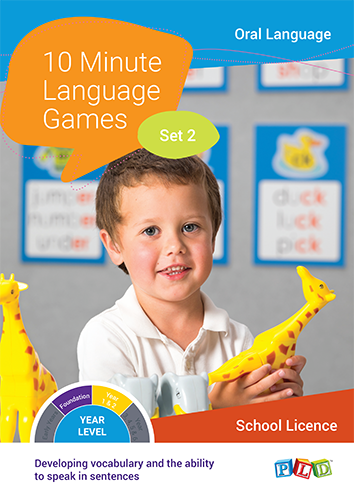
10 Minute Language Games – Set 2

$82.50 (inc. $7.50 GST)
Code: 10m5
Year Level: Foundation, Individual licence, School Licences, Year 1 & 2
Book
Book
Developing vocabulary and the ability to speak in sentences.

Introduction to the Program
This program is designed to provide quick, engaging activities that foster oral language development in young learners. Each game takes just 10 minutes, making it easy to incorporate into daily routines or classroom sessions.

The Program Includes:

  • 6 themes, each with 3 different language games
    • Naming and speaking in single words
    • Sorting and speaking in short sentences
    • Describing and connecting several sentences together
  • Vocabulary focused on real-life categories relevant to children
    • Food
    • Things you wear
    • Farm animals
    • Things that take you places
    • Toys
    • Around the home
  • Activities tailored to 3-5 year old language development stages

Other Programs within the Range:

Links to the Teaching Sequence Manuals
This product is mentioned in the Early Years Teaching Sequence Manual

10m5

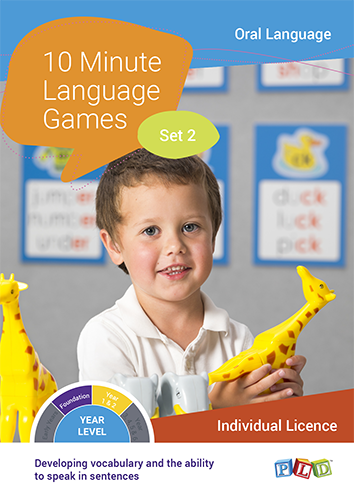
10 Minute Language Games – Set 2 - Individual Licence

$41.25 / year (inc. $3.75 GST)
Code: 10m5il (Individual Licence)
Year Level: Foundation, Individual licence, School Licences, Year 1 & 2
Book
Book
Add to quote

This is a PLD Individual Licence resource. By purchasing this licence, this program will be accessible as a digital flipbook that will be stored in your secure account on the PLD website and may only be accessed by an individual user, being the Purchaser. The program will be accessible as a digital flipbook that can be accessed by the purchaser on any device for as long as the licence is active. An Individual Licence is valid for 12 months from the date of purchase. Sharing of an Individual Licence or account credentials for the purpose of sharing an Individual Licence is a breach of Australian Copyright Law and PLD Terms of Use. For more information, visit our Individual Licence FAQ.

Developing vocabulary and the ability to speak in sentences.

Designed by speech pathologists for teachers and parents, 10 Minute Language Games – Set 2 for 4 to 6-year-olds presents numerous short fast-paced games and activities that are fun and engaging and which facilitate:

  • Vocabulary expansion
  • Practice retrieving theme-based vocabulary from children’s ‘mental dictionaries’
  • The application of theme-based vocabulary to categorising and description tasks
  • Examples of age-appropriate and non-age appropriate answers

Children with language and semantic delays will often have:

  1. Gaps in their vocabulary.
  2. Difficulty retrieving their vocabulary from their mental dictionaries. Children with vocabulary retrieval problems will inconsistently retrieve appropriate words (e.g. on occasions they will label ‘lion’ appropriately and on other occasions, the labels ‘tiger or leopard’ will be used.)
  3. Other children may demonstrate relatively age-appropriate vocabularies but are non- automatic in the retrieval of the appropriate words. These children typically require additional ‘think’ or processing time.

Activity 1 – Naming and Speaking in Single Words: The vocabulary-based games are fun and engaging ways to rehearse the labelling of common category based items.
Activity 2 – Sorting and Speaking in Short Sentences: In the sorting tasks children are given the opportunity to become familiar with the characteristics that best describe the pictured items.
Activity 3 – Describing and Connecting Several Sentences Together: In the describing tasks children are given the opportunity to give clues and therefore describe the pictured items.

Each theme has 3 activity cards and 24 colour vocabulary cards. We recommend introducing the themes in the following order: Fruit & Vegetables, Weather & Seasons, Animals, Under the Sea, Minibeasts & Occupations.

This product is mentioned in the Foundation Teaching Sequence Manual on page 13 and the Year 1 & 2 Teaching Sequence Manual on page 20.

The programs within the range include:

10m5

10 Minute Language Games – Set 2 - School Licence

From $65.00$65.00 incl. GST / year (inc. $5.91 GST)
Code: 10m5vs (School Licence)
Year Level: Foundation, Individual licence, School Licences, Year 1 & 2
Book
Book

Select your school size

Extra small

(<49 students)

Small

(50-149 students)

Medium

(150-349 students)

Large

(350+ students)

Add to quote

This is a PLD Whole School Licence resource. By purchasing this licence, this program will be accessible as a digital flipbook that will be stored in your secure account on the PLD website. The program will be accessible as a digital flipbook that teachers can access on any device for as long as the licence is active. A School Licence is valid for 12 months from the date of purchase and can be shared with all staff employed at the school. We highly recommend that either the Principal, Deputy Principal or a member of the admin team purchase the School Licence in order to manage the account and its users. For more information, visit our Whole School Licence FAQ.

Developing vocabulary and the ability to speak in sentences.

Designed by speech pathologists for teachers and parents, 10 Minute Language Games – Set 2 for 4 to 6-year-olds presents numerous short fast-paced games and activities that are fun and engaging and which facilitate:

  • Vocabulary expansion
  • Practice retrieving theme-based vocabulary from children’s ‘mental dictionaries’
  • The application of theme-based vocabulary to categorising and description tasks
  • Examples of age-appropriate and non-age appropriate answers

Children with language and semantic delays will often have:

  1. Gaps in their vocabulary.
  2. Difficulty retrieving their vocabulary from their mental dictionaries. Children with vocabulary retrieval problems will inconsistently retrieve appropriate words (e.g. on occasions they will label ‘lion’ appropriately and on other occasions, the labels ‘tiger or leopard’ will be used.)
  3. Other children may demonstrate relatively age-appropriate vocabularies but are non- automatic in the retrieval of the appropriate words. These children typically require additional ‘think’ or processing time.

Activity 1 – Naming and Speaking in Single Words: The vocabulary-based games are fun and engaging ways to rehearse the labelling of common category based items.
Activity 2 – Sorting and Speaking in Short Sentences: In the sorting tasks children are given the opportunity to become familiar with the characteristics that best describe the pictured items.
Activity 3 – Describing and Connecting Several Sentences Together: In the describing tasks children are given the opportunity to give clues and therefore describe the pictured items.

Each theme has 3 activity cards and 24 colour vocabulary cards. We recommend introducing the themes in the following order: Fruit & Vegetables, Weather & Seasons, Animals, Under the Sea, Minibeasts & Occupations.

This product is mentioned in the Foundation Teaching Sequence Manual on page 13 and the Year 1 & 2 Teaching Sequence Manual on page 20.

The programs within the range include:

ISBN : 9 781925 769227
  • PLD's Whole School Literacy Plan
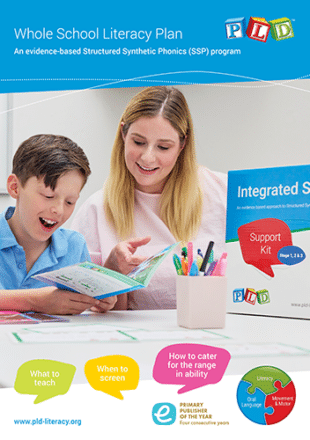
    PLD’s Whole School Literacy Plan
    The document outlines how to implement PLD's literacy, Movement and Motor and Oral Language resources during the Early Years, Foundation, Year 1 & 2 and across Years 3 to 6. Each page provides suggested time frames and implementation recommendations.

    The purpose of this document is to provide an implementation outline to assist schools in scheduling the PLD programs within a broad school-based strategy. When

  • Speech and Language Development Milestones – 5 years old
    Speech and Language Development Milestones – 5 years old
    This milestone poster/sheet details the speech and language developmental milestones for 5 year olds.

    Designed by speech and language pathologists, the speech and language milestone sheets provide a list of typical milestones that should be attained by specific ages.

  • Oral Language Concept Development - Ages 2 - 6
    Oral Language Concept Development – Ages 2 – 6
    A milestone and information sheet which outlines the timeline for developing oral language concepts in children aged 2 to 6 years.

    A downloadable poster covering the oral language developmental stages from aged 2 through to age 6. See our Copyright Terms of Use at https://pld-literacy.org/help-pages/copyright-policy/.

  • Speech Sound Development - 3 to 8 years old
    Speech Sound Development – 3 to 8 years old
    The milestone poster/sheet details the age related milestones for speech sound development in children aged 3 to 8 years.

    Many parents, early childhood workers and teachers will wonder if a child speech is normal. Most children’s speech becomes clearer gradually as they hear and

People who viewed this also viewed...

  • Semantic Scenes and Questioning – Set 2
    Semantic Scenes and Questioning - Set 2
    A school or home based program designed to equip teachers and parents of 5-6 year old children with activities that will develop semantic knowledge.

    Semantic Scenes and Questioning – Set 2 is designed to equip teachers and parents of 5-6 year old children with activities that will develop semantic knowledge. A good grasp of semantics broadens a child’s understanding of the meaning of words, which then helps them to understand what they hear or read and also helps them to express exactly what they want to say. A child who is struggling with semantics will be the child who: Can’t stay on the topic of simple story or news telling, but goes off on unrelated tangents. Takes a long time to think of particular words they want to use in conversation. Uses non-specific vocabulary such as ‘that’ ‘there’ ‘this one’. Has difficulty sorting items into groups, describing them, and finding differences and similarities. Has difficulty understanding instructions that include time vocabulary such as ‘before’ ‘after’ ‘first’ etc. ‘Semantics’ refers to the meaning of sentences and words and how words relate to one another. That is, whether words belong in groups or categories together (e.g. Apples and oranges and pears are all fruit), whether they are similar to each other, or different and the features they have e.g. Size, shape and colour. Another way to think of semantics is like a network or web. Each word we speak or read has a place in this web. Each word has other words linked to it, some closely related and some distantly related. Each word belongs to several groups, some big and some small and each word has a definition that sets it apart from other words that are similar. Some words are related by the fact that they are actually opposites! All this information surrounding words is what we aim to teach young children about the vocabulary that is appropriate to their stage of development and life experience. Semantics is one facet of oral language. Given that oral language is not only a strong predictor of academic and social success but also a necessary requirement for good mental health, it is important that parents and teachers have the skills and resources needed to facilitate the development of oral language in young children. The aim of this program is to train parents and teachers to structure and facilitate developmentally appropriate semantic activities for 5 to 6 year old children. This program provides: Semantic activities and accompanying picture resources. Examples of appropriate and inadequate responses for 5-6 year old children. Techniques and strategies to implement when a child provides an inadequate answer. Features: Colour thematic picture scenes include the zoo, transport, at home, food, school, toys, Australian animals, clothes, under the sea and birthday party. Specific semantic questioning is outlined for each picture scene. Examples of appropriate and inadequate responses for 5-6 year old children. Techniques and strategies are outlined when a child provides an inadequate answer. This product is mentioned in the Foundation Teaching Sequence Manual on page 13 and the Year 1 & 2 Teaching Sequence Manual on page 20. The programs within the range include: Semantic Scenes and Questioning – Set 1 Semantic Scenes and Questioning – Set 2

    $82.50$82.50 incl. GST
  • Comprehension Questions for 5 Year Olds
    Comprehension Questions for 5 Year Olds
    Picture Book Program for 5 Year Olds: Perfect for Home or School

    Comprehension Questions for 5 Year Olds is a home or school resource designed to support oral language development in young children. From a young age, children should be verbal, actively engage in social interactions and understand simple, literal questions about their surroundings. By age 5, children begin answering more complex questions that involve predicting, explaining outcomes and considering alternative possibilities. This program, developed by speech pathologists, supports the development of these foundational comprehension skills using engaging picture books to ask age-appropriate questions and assess oral responses. Oral language skills are critical for social interaction and academic success. Program Includes: Picture Book Recommendations: List of developmentally appropriate Picture Book recommendations, such as &apos;A Lion in the Night&apos;, &apos;The Gruffalo&apos; and &apos;The Very Hungry Caterpillar&apos;. 42 Question Cards for Repeated Reading Sessions: Each card contains sample questions (over four days) and model answers based on each recommended picture book. Questions focus on Blank Level 3 and 4 skills, such as &apos;Why did that happen?&apos;, &apos;What would you use?&apos; or &apos;Why can&apos;t we?&apos; Instruction Booklet: Guidance for presenting in group, class or home settings. Strategies for Success: Techniques for responding to inadequate answers. Progress Check: Two assessments to monitor comprehension skill development. Other Programs within the Range: Comprehension Questions for 3 Year Old (Mc3) Parent Training Video: 3 Year Olds Comprehension Questions for 4 Year Old (Mc4) Parent Training Video: 4 Year Olds Comprehension Questions for 5 Year Old (Mc5) Parent Training Video: 5 Year Olds Comprehension Questions for 6 and 7 Year Old (Mc6) Parent Training Video: 6 and 7 Year Olds Comprehension Questions for 8 and 9 Year Old (Mc8) Parent Training Video: 8 and 9 Year Olds The full set of Comprehension Questions Range (Mc3/4/5/6/8) Links to the Teaching Sequence Manuals: This product can be used to support the implementation of the Foundation Teaching Sequence Manual on Page 14

    $82.50$82.50 incl. GST
  • 10 Minute Language Games – Set 2
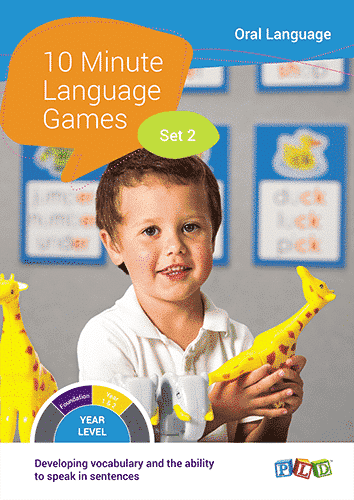
    10 Minute Language Games - Set 2
    Developing vocabulary and the ability to speak in sentences.

    Introduction to the Program This program is designed to provide quick, engaging activities that foster oral language development in young learners. Each game takes just 10 minutes, making it easy to incorporate into daily routines or classroom sessions. The Program Includes: 6 themes, each with 3 different language games Naming and speaking in single words Sorting and speaking in short sentences Describing and connecting several sentences together Vocabulary focused on real-life categories relevant to children Food Things you wear Farm animals Things that take you places Toys Around the home Activities tailored to 3-5 year old language development stages Other Programs within the Range: 10 Minute Language Games – Set 1 10 Minute Language Games – Set 2 Links to the Teaching Sequence Manuals This product is mentioned in the Early Years Teaching Sequence Manual

    $82.50$82.50 incl. GST